Tuesday, July 24, 2007

One of the Greatest Modern Composers: Stravinsky

Frank Luger headshot by Frank Luger

When I was in my pre-teens, my parents had arranged for me to take piano lessons. I was not particularly good at it, except for manual dexterity; but I had little ear for music, and even less patience for learning the delicate technicalities. It took about six months of ‘torture’ before my training was abandoned as hopeless. However, during that time, my private tutor, who was no lesser personage than Gabriella Bartók, the niece of the world-famous composer Béla Bartók, had often admonished me and tried to motivate me by insisting that I should aim at nothing less than excellence. She used to cite the examples of famous Hungarian musical geniuses, such as Liszt, Kodály, and Bartók; and, since this was already during the Stalinist times, for political ‘correctness’ she also cited such great names as Tchaikovsky, Rimsky-Korsakov, Rachmaninoff, and very often, Stravinsky.

She had never met the other three Russians, but she had trained for a while with Igor Fedorovich Stravinsky (1882-1971) in her youth; and so she was in position to tell me many stories, even amusing anecdotes. Now, it has been a generation (30 years) that Stravinsky died (Gabriella Bartók died even earlier, due to breast cancer, if I remember correctly); therefore, as a bit of commemoration, let me relate what I recall of her Stravinsky stories, interlaced, spiced, and completed with actual historical details.

While vacationing in Heidelberg, Germany, on a hot Summer afternoon in 1902, Rimsky-Korsakov was approached by a 20-year old law student from the University of St-Petersburg (later renamed Leningrad, now back to its old name). Introducing himself as the son of one of Russia’s foremost opera stars, the youth begged the composer to listen to a piece he had recently written and to tell him whether or not it showed any of the talent necessary for a career in music. Taken by surprise by the young man’s insistence but being delighted with his evident enthusiasm for music, Rimsky-Korsakov agreed to a hearing. The student played the piano for about half an hour, then respectfully awaited the ’verdict’ of the already famous composer.

“Young man, your music is quite nice,” Rimsky-Korsakov reportedly told him; “but in all fairness to you, I would suggest that you continue with your law studies. However, should your interest in music remain, you might perhaps enroll in some formal courses in counterpoint and harmony. Then, maybe, you will come back and play for me again and I will be able to give you a more favorable assessment.”

His hopes dashed for the moment, the crestfallen Stravinsky took the advice and returned to his law books. Music, however, soon gained the upper hand again. Writing a piano sonata, a year later he called on Rimsky-Korsakov a second time. The composer greeted him warmly and listened to his music intently, apparently impressed with what he was hearing. Occasionally he asked Stravinsky to repeat a specific passage, nodding and keeping time to the music when it was played. Then came the second verdict:

“You asked me once before if you had any ability whatsoever and I told you to continue with your law studies. I’ve just changed my mind. You are wasting your talents with law. Come to me tomorrow morning- early, mind you- and we will begin your training in serious instrumentation.”

In later years Stravinsky was to recall, the weeks and months he spent with Rimsky-Korsakov were among the happiest in his life. As a teacher, the composer was merciless. He drove his young apprentice and drove him very hard. Anything short of perfection brought down his wrath. Perfection, itself, he dismissed with scarcely a word of praise. “A man’s music,” Rimsky-Korsakov used to explain, “should always be perfect, so why should we applaud something that is so basic to successful composing.”

Prompted by such admonishings, late in 1907 Stravinsky completed his first large work, the “Symphony in E-flat major.” Performed in St-Petersburg on January 22, 1908, it instantly met with critical acclaim. A second work finished soon afterward and named “Le Faune et la bergère” (Fauna and the shepherdess) did not fare as well, but it did prove to be more than sufficient to bolster Stravinsky’s rising stature in the world of music.

Galvanized into action, confident as he had never been before, tireless in his work, Stravinsky threw himself into his music. Secretly, he began to compose a new orchestral work, which he hoped to present as a gift to Rimsky-Korsakov upon the forthcoming marriage of the master’s daughter. Called “Fireworks”, it was finished just a week before the wedding. Delighted with his surprise, Stravinsky packed up his score and shipped it off to his revered master. However, by some irony of fate, Rimsky-Korsakov was never to see it. On the day that it arrived, he died. One of the world’s greatest composers had passed on and for Igor Stravinsky, the loss was a terrible blow. Friend, teacher, and colleague, Rimsky-Korsakov had been the young composer’s guide and inspiration.

Presented in St-Petersburg, “Fireworks” exerted a profound influence on the future of the rising composer. In the audience, the night of its debut, was Serge Diaghilev, soon to become famous as the mastermind behind the magnificent ‘Ballet Russe’ [Russian Ballet, later almost synonymous with ‘Bolshoi’ even though ‘Bolshoi’ was the name of the largest (as it means “big” or “great” in Russian) and most elegant theater in Moscow during and after Stalin]. Hearing Stravinsky’s music, Diaghilev invited the composer to orchestrate two Chopin pieces for a forthcoming ballet performance. Stravinsky did, and the results were so outstanding that he was commissioned to undertake a major work revolving around an old Russian myth- the tale of the Fire-Bird.

It took Stravinsky nearly a year to complete his task, but at last, on June 25, 1910, “L’Oiseau de Feu” or “The Fire-Bird”, was presented at the Paris Opera. The audience went wild with delight. Stravinsky was given an incredible ovation. Debussy, hearing the score, rose at the conclusion of the ballet and hurled himself into Stravinsky’s arms. Gabriel Pierne, who conducted that evening, later declared, “The Fire-Bird” is music such as I have never heard before. The world will not soon forget it. Mark my words. Igor Stravinsky will someday help free the musical thought of today and lead it in new directions.” And so it proved. “The Fire-Bird” established Stravinsky’s reputation and carried his name to music lovers around the globe. Elated with his triumph, the composer immediately plunged into a new work. Titled “Petrouchka”, it was first seen in Paris in 1911. To ensure its success, Diaghilev had seen to it that Nijinsky and Karsavina were the ballet’s principal dancers, that the finest supporting cast to be found anywhere was on hand, and that the settings were of unmatched beauty.

Paris received “Petrouchka” with even more enthusiasm than that attending the debut of “The Fire-Bird”. The city’s newspapers, next morning, hailed Stravinsky as a personage of music equal in stature to France’s beloved Claude Debussy. And Debussy himself declared, “That man injects a vital force into music that will carry him- and music- very far”.

Following “Petrouchka” came “The Rite of Spring”, a ballet which perhaps evoked one of the most fantastic exhibitions in the history of music. Presented on May 29, 1913, rarely has a composition ever carried its audience away so completely. Even for Igor Stravinsky, “The Rite of Spring” marked a monumental turning point in his career. His success established, the piece shook the musical world to its very roots and made him one of the most loved or most despised, most defended or most maligned figures in the history of his art. In rapid succession, he proceeded to compose such works as the opera-oratorio “Oedipus Rex”; the ballet “Apollon Musagete”; the suite “Pulcinella”; and the ballet “L’Histoire de Soldat” (Soldier’s History).

Visiting the United States for the first time in 1925, Stravinsky was much impressed with what he saw. Musical America, on the other hand, was just as impressed with what it saw in him and welcomed the composer with open arms. The various tours on which he embarked in the years that followed were all highly successful, so much so, as a matter of fact, that when Stravinsky completed his ballet “Jeu de Cartes” (Card Game) , he decided it would be given its premiere in New York. Presented in 1937; the audience proved to be every bit as enthusiastic as the Parisian groups that had greeted the ballets “The Fire-Bird” and “Petrouchka”. With the onset of World War II, Stravinsky abandoned his home in the outskirts of Paris. Traveling to the United States and eventually settling in California, be became a naturalized American citizen and plunged back into his work. His major American works have included the magnificent opera “Rake’s Progress”; the ballet “Orpheus”; and the controversial “symphony in Three Movements”.

This is where I should stop the storytelling, because my own musical training had stopped in the mid-1950’s. Stravinsky had lived and produced until his death in 1971, but I know nothing of his late period in life. At any rate, it is generally recognized that already in the mid-1950’s he was acknowledged as one of the world’s greatest modern composers. Igor Fedorovich Stravinsky had achieved his aims while he was still alive, regardless of difficulties; and thus had been successful in avoiding merely posthumous recognition, the lamentable fate of many great artists.

Read More...

Tuesday, February 13, 2007

Forever

Sean J. Vaughan headshot by Sean J. Vaughan

This is my friend Jon Bolton's cover of the song "Forever" that he did for his girlfriend for Valentine's day today! Jon played all the instruments and did all the vocals.

(Download the mp3 file.)

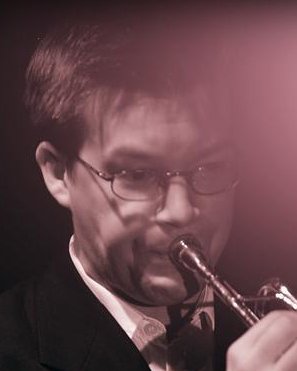
Jon Bolton plays in "The Beatniks" and "The Herding Cats" bands. The picture of Jon above is from when "The Herding Cats" played the main stage at The Chicago House of Blues.

"Forever" is originally by John Stamos, perhaps still best known for playing Jesse Katsopolis on the TV sitcom "Full House" but is also on ER and has toured playing drums for the Beach Boys. You can clearly hear the Beach Boys influence in this song. You can see the music video on YouTube.

Read More...

Monday, October 23, 2006

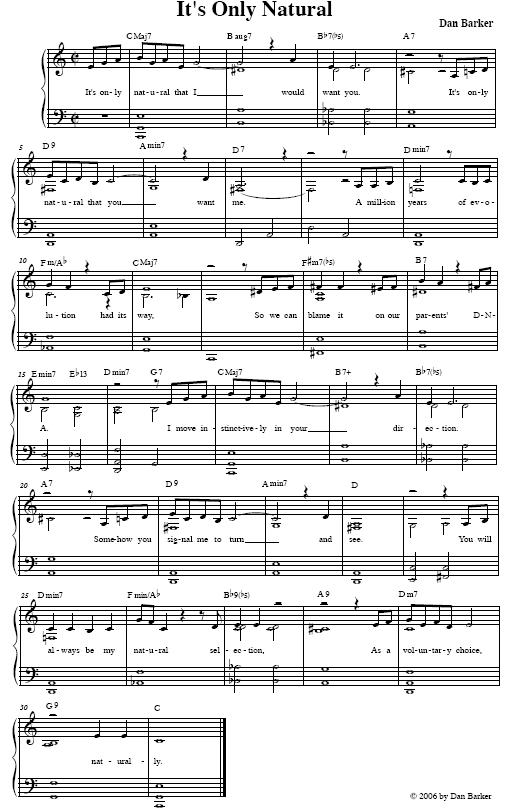
"It's Only Natural"

(lyrics and music to a new song)

Dan Barker headshot ©2006 by Dan Barker

Song lyrics are not meant to be read like a poem . . . they tend not to read as well on paper as they sound in a song . . . but these lyrics are interesting, I think, as a "popular" song, in that they incorporate evolution as the most natural idea. I was inspired by Dawkins's book Unweaving the Rainbow, where he makes a plea for more science in the arts.

Also, I wanted to write lyrics like Cole Porter, that can be sung by male or female, gay or non-gay.


IT'S ONLY NATURAL


It's only natural that I would want you;
It's only natural that you want me.
A million years of evolution had its way,
So we can blame it on our parents' DNA.

I move instinctively in your direction -
Somehow you signal me to turn and see.
You will always be my natural selection,
As a voluntary choice, naturally.

Download a pdf version of the score.

Read More...

Tuesday, October 10, 2006

Absolute Pitch

by Staffan A. Svensson

Have you ever wondered how some people are able to sing a specific note on command, simply tell you "that note is a G flat" or "the key of the song is C"? These people are using something called absolute pitch, and in this article I try to briefly describe what it is, where it comes from and how you probably have some of it yourself, without even knowing it.

Absolute pitch (sometimes called "perfect pitch") contrasts to Relative pitch, and both are used to describe how a person hears notes, or more specifically pitches. These terms are usually used in music, but are equally valid whether you are talking about music, engine sounds or birdcalls.

When someone uses relative pitch, they compare one pitch to another pitch, so to be able to use relative pitch one needs a minimum of two notes (or some other sound with a pitch). When someone hears that a melody first goes up and then down or that the pitch goes higher when an engine accelerates, they are using relative pitch. This type of listening is taught in music schools and is the basis for all types of intervals, scales and chords. Almost all people have some level of relative pitch, and even those who are tone deaf (approx. 4%[1]) are not completely without this ability, even if it is markedly reduced.

When someone uses absolute pitch, they are listening to what frequency a tone or a group of notes have. You only need a minimum of one audible pitch to use it; it is not about comparing it to anything. This has for a long time been seen as a sort of almost magical innate ability to name a pitch or to sing a specific note on command. Some have seen it as a curiosity with little practical significance, while for others it has been the holy grail of music excellence. Lack of knowledge has made the whole concept a well-nourished growing ground for rumours and guesses.

Relative pitch has never been a problem for people to understand. Almost all people hear the difference between a high note and a low note if you play one after the other, and some people do this better than others. No mystery there. But what of this weird absolute pitch? What so few realized is that some people hear frequency differences better than others. In the same way people see the differences in frequency when we see colours, we also hear them (we can only see about one "octave" but a person with good hearing can hear 10 octaves). But everyone that has potential to see colour seems to naturally develop the ability to see differences in colours, while few people seem to hear the frequency differences. Why? Part of the answer, as with many other hard questions, comes with defining what we really mean by the question. If hearing colours means a person can identify tones played on any instrument and name them correctly each time, then very few will qualify. If hearing colours instead means someone can hear that a melody played in one key sounds or feels different in some way, or has a different "flavour" to it, compared to the exact same melody played in another key, suddenly this group includes most people. Such an experience indicates the same kind of ability, only not refined enough to be able to differentiate between and thus identify semitone intervals as standardised in western music.

The American Heritage Dictionary defines absolute pitch as the "ability to identify any pitch heard or produce any pitch referred to by name"[2]. Other definitions include "capacity to identify any tone upon hearing it sounded alone or to sing any specified tone"[3] and "that sense which some people possess of the actual pitch of any note heard"[4]. There exists no word for weaker forms or for this ability as a whole, and this may partly explain why so few people realize the simplicity of the phenomenon.

So why doesn't every person possess excellent absolute pitch? It does not seem as important to us as seeing colours, so even though the ability to learn is innate, practise is required to get it to the level where one can use it in music. Most people do not have that need, so the ability never gets very cultivated. Many have no idea that the possibility exists, and if they do not happen to discover it for themselves they will never even try to develop it. This accidental discovery is probably what causes some children to develop it spontaneously.

One theory suggests absolute pitch evolved to "subserve speech, and that it may be readily acquired by the association of pitches with meaningful words very early in life, during the critical period in which infants acquire the main features of their native language"[5]. Tonal languages use this particular feature of language more than many western languages, including English, so do people with a tonal first language have a better sense of absolute pitch? It turns out that they do, and that it carries over to music. Deutsch et al. tested Chinese and US music students ages 17-34 for absolute pitch (defined as at least 85% correct answers identifying individual piano notes) gave results like these: "For those who had begun musical training between ages 8 and 9, roughly 42% of the Chinese students met the criterion whereas none of the US nontone language speakers did so."[6] It has been known a long time that most of the people with a good absolute pitch started their music training when very young, and this certainly seems to indicate if not a critical then at least a sensitive period for this type of development.

At this point you might ask yourself if you have some noticeable level of absolute pitch, so why not try it for yourself? You may not have the opportunity to listen to the same musical piece in different keys in order to compare them unless you or someone you know can play them, but if you have an instrument it is easy to pick it up and listen to individual notes. Play long notes and take your time. I would not be surprised if you thought the tones do not actually sound exactly the same. Some notes may sound a little "softer", others a little more "twangy". Putting it into words like this is like describing colour to someone totally colour-blind, and some people prefer instead to call the notes by colours (and no, those who do seldom agree which note is which colour). Also, some of the subtle differences you might hear could be because of the instrument (the different strings on the guitar will not sound the same), but these are usually easy to spot. The important thing is to take your time. Good luck!

References

[1] http://www.annalsnyas.org/cgi/content/full/1060/1/311, Sloboda, J.A., K.J. Wise & I. Peretz (2005). Quantifying tone deafness in the general population. Ann. N. Y. Acad. Sci. 1060: 255-261.

[2] The American Heritage Dictionary of the English Language, Fourth Edition ©2000, updated 2003, Houghton Mifflin Company

[3] http://www.reference.com/browse/columbia/absolpit, quoting The Columbia Electronic Encyclopedia Copyright © 2004, Columbia University Press

[4] http://www.highbeam.com, quoting The Concise Oxford Dictionary of Music, 1996

[5] http://psy.ucsd.edu/~ddeutsch/psychology/deutsch_research9.html, from the homepage of Diana Deutsch, Ph.D.

[6] http://www.aip.org/148th/deutsch.html, Deutsch et al. (2004). Perfect Pitch in Tonal Language Speakers Carries Over to Music, popular version of paper 3pMUb3, 148th ASA meeting, San Diego, CA


If you are interested in developing absolute pitch, this is the most pedagogical and well worked-out source I have come by so far:

Burge, D.L (1999) The Perfect Pitch Ear-training Supercourse. Information can be found at http://www.perfectpitch.com/

Read More...

Patriotism Was His Religion

Irving Berlin the Agnostic

by Dan Barker

Originally published by the Freedom From Religion Foundation, Inc.

This article was included in the 52nd issue of the Carnival of the Godless.

How many patriotic Americans, proudly singing "God Bless America," realize that the song they are intoning was written by a man who did not believe in God?

Or that it was intended as an anti-war anthem?

Irving Berlin is by any measure the greatest composer of popular American music, with hundreds of enduring hits, such as "Alexander's Ragtime Band," "I Love A Piano," "Always," "Blue Skies," "Let's Have Another Cup of Coffee," "Cheek to Cheek," "Marie," "Play a Simple Melody," "There's No Business Like Show Business," "Anything You Can Do," "Easter Parade," and "White Christmas."

Born in 1888 into a Russian Jewish family who came to New York City to escape religious persecution when Irving was five years old, he quickly shed his religious roots and fell in love with America. He became an American citizen when he was 29. "Patriotism was Irving Berlin's true religion," writes biographer Laurence Bergreen in As Thousands Cheer: The Life of Irving Berlin (1990).

Irving Berlin was "not a religious person," according to his daughter Mary Ellin. Relating the story of Irving's marriage to Ellin Mackay in 1926, whose devout father had a deep reluctance to welcome a "lower-class" Jew into the wealthy Catholic family, she writes:

"About religion -- Jew and Catholic. My mother has broached the subject of being married by a priest. She herself, though she goes to mass, keeps up appearances, doesn't believe in all that anymore, she assures him. She has had such a strange religious upbringing: a Protestant like her mother till the divorce, a Catholic since. But a priest might help soften her father. Irving, however, the cantor's son, doesn't see himself being married by a priest. Though he is not a religious person, doesn't even keep up appearances of being an observant Jew, he does not forget who his people are." (Irving Berlin: A Daughter's Memoir, by Mary Ellin Barrett, 1994.) They got married in an unannounced secular, civil ceremony at the Municipal Building, not a church or synagogue.

Once they had children, Mrs. Berlin did try to keep up a minimal appearance of religious tradition. Mary Ellin writes that her unbelieving parents "had their first bad fight when my mother suggested raising me as a Catholic . . . ."

The Berlins had three daughters. "Both our parents," Mary Ellin recalls, "would pass down to their children the moral and ethical values common to all great religions; give us a sense of what was right and what was wrong; raise us not to be good Jews or good Catholics or good whatever else you might care to cite, but to be good (or try to be) human beings. . . . When we grew up, she said, we would be free to choose--if we knew what was best for us, the religion of our husband. . . . It wouldn't quite work out, when we 'grew up,' as my mother hoped. All three of us would share our father's agnosticism and sidestep our husband's faiths."

The man who wrote "White Christmas" actually hated Christmas. "Many years later," Mary Ellin writes, "when Christmas was celebrated irregularly in my parents' house, if at all, my mother said, almost casually, 'Oh, you know, I hated Christmas, we both hated Christmas. We only did it for you children.'"

So why did an agnostic humanist who hated Christmas write the song "White Christmas?"

Undoubtedly, it had something to do with the businessman in him. When his friend Cole Porter confessed that he hated his own "Don't Fence Me In," a surprise international hit, Berlin advised him, "Never hate a song that has sold a half million copies." (Cole Porter, by William McBrien, 1998.)

Christmas, for Irving Berlin, was not a religious holiday: it was an American holiday. He simply needed a melody in 1940 for a show called Holiday Inn, an escapist "American way of life" musical (when all hell was breaking loose in Europe) which called for a song for each holiday. The words to "White Christmas" are not about the birth of a savior-god: they are about winter, the real reason for the season.

Biographer Bergreen writes about the Christmas of 1942:

"Accustomed to traditional holiday celebrations, Ellin arranged for a Christmas tree to be delivered to Berlin's hotel suite in Detroit, where he was performing in This is the Army, and with the girls' assistance she proceeded to decorate the tree while a photographer memorialized the occasion. The photograph of the songwriter, his wife, and family decorating the Christmas tree, when reproduced in the newspapers, served as another plug for 'White Christmas.' Berlin, the cantor's son, rationalized his participation in the Christmas rite on the basis that it had become an American holiday, and as a professional patriot, he made a habit of appropriating all things American to himself."

This U.S. postage stamp (above left) was issued in a ceremony in New York City in September 2002, one year after the 9/11 WTC attacks. Out of agnostic Irving Berlin's 1,500+ songs, "God Bless America" was chosen to represent his life's work.

"God Bless America" was originally written in 1918 for a patriotic WWI show. Irving Berlin had joined the army, and (according to Harry Ruby, his pianist colleague at Camp Upton) to avoid getting up early each morning, Irving convinced his superiors to allow him to serve his country by producing a musical for military PR. It was a light-hearted life-in-the-army show called Yip, Yip Yaphank, including the comic bugle call "Oh, How I Hate to Get Up In The Morning."

As he was finishing the writing, "Berlin composed one unashamedly patriotic anthem," Bergreen writes, "which spoke of prairies and mountains and oceans white with foam. He called it 'God Bless America,' but even as he dictated it to Ruby, Berlin became insecure about its originality. 'There were so many patriotic songs coming out everywhere at the time,' Ruby recalled. 'Every song-writer was pouring them out.' As he wrote down the melody, Ruby said to Berlin, 'Geez, another one?' Deciding that Ruby was right, that the song was too solemn to ring true for the acerbic doughboys, Berlin cut it from the score and placed it in his trunk. 'Just a little sticky' was the way he described the song. 'I couldn't visualize soldiers marching to it. So I laid it aside and tried other things.'"

The song was forgotten for two decades. During those years, Irving Berlin's attitude toward war evolved.

In 1938, while the United States was resisting joining the new European conflict, the singer Kate Smith was looking for a song to perform during her Armistice Day broadcast--a "song of peace," she said. It happened that Irving Berlin was also casting about for an idea for a pacifist anthem. Almost no one in America wanted to go to war. "I'd like to write a great peace song," he told an interviewer, "but it's hard to do, because you have trouble dramatizing peace. Easy to dramatize war. . . . Yet music is so important. It changes thinking, it influences everybody, whether they know it or not."

He tried writing a couple of peace songs, but they were "too much like making a speech to music," he said. It then occurred to him to dig up that discarded composition from 1918.

"I had to make one or two changes in the lyrics," Berlin continued in the interview, "and they in turn led me to a slight change and, I think, an improvement in the melody. . . . One line in particular; the original line ran: 'Stand beside her and guide her to the right with a light from above.' In 1918 the phrase 'to the right' had no political significance, as it has now. So for obvious reasons I changed the phrase to 'Through the night with a light from above,' and I think that's better.

"One of the original lines read: 'Make her victorious on land and foam, God bless America, my home sweet home.' Well, I didn't want this to be a war song, so I changed that line to 'From the mountains to the prairies to the oceans white with foam, God Bless America, my home, sweet home.' This longer line altered the meter and led to a change in the melody."

Kate Smith sang Berlin's peace anthem on national radio on November 11, and it became an immediate hit.

"The reason 'God Bless America' caught on," Berlin tried to explain to The New York Times in 1940, "is that it happens to have a universal appeal. Any song that had that is bound to be a success. . . ."

Discussing the mystery of what makes a hit song, he continued: "The mob is always right. It seems to be able to sense instinctively what is good, and I believe that there are darned few good songs which have not been whistled or sung by the crowd."

This was "a populist credo, as well as a merchant's," Bergreen observes. Irving Berlin may have been right about the business of the mob's taste in music, but he never envisioned "God Bless America" becoming a pro-war anthem, as it is often sung by "the right" today.

Some of us freethinkers might wonder why an agnostic would write a song about "God" at all, especially a Jewish agnostic who must have known that the capital-G "God" is perceived by most to be the Christian deity. But just as "White Christmas" is not about Christ, "God Bless America" is not about God; it is about America. Irving Berlin was not an atheist evangelist; he was a songwriter and businessman who wrote and sold music that reflected the popular mood.

"'God Bless America' revealed that patriotism was Irving Berlin's true religion," Bergreen writes. "It evoked the same emotional response in him that conventional religious belief summoned in others; it was his rock."

Even though Irving Berlin occasionally used the word "God" in a poetic sense, never once in his more than 1,500 songs did he ever promote religion.

"I don't write church lyrics on the side," he once told a journalist, "have no passion for flowers, and never read Shakespeare in the original Greek."

In fact, he sometimes poked fun at faith.

Four years after the original "God Bless America," Irving Berlin wrote "Pack Up Your Sins and Go to the Devil in Hades," a song for his 1922 Music Box Review performed at the new Music Box Theater in New York, which he had built especially for his productions. The song was about the recent "jazz" craze that was sweeping the country, which was being condemned by the Church.

"In the press and from pulpits, self-appointed guardians of public morality decried this dancing bestiary," Bergreen writes. "Matters became so serious that a New York grand jury investigated, and after due deliberation arrived at a 'presentment condemning the turkey trot and kindred dances and laying particular stress on the fact that the hotels and cafes allow such dances.' " People were arrested for dancing! Some lost their jobs for dancing during lunch breaks.

During Berlin's 1922 rebellious revue, an attractive comedienne named Charlotte Greenwood, dressed in a red devil suit, dispatched popular jazz musicians to hell singing, "They've got a couple of old reformers in heaven, making them go to bed at eleven. Pack up your sins and go to the devil, and you'll never have to go to bed at all." (See sidebar.) The song is the perfect antidote to "God Bless America."

Irving Berlin died quietly at home in 1989 at the age of 101. A patriotic agnostic who devoted himself to enriching America, he lived a productive life full of family values, hard work, determination, and joy. He did not believe in an afterlife; but maybe he did jokingly wish for a hell, because "all the nice people are there."

As Mark Twain said, "Heaven for climate; hell for society." If there is a hell, we unbelievers will be in great company.

Dan Barker, a former minister, is a staff member of the Freedom From Religion Foundation. Dan's father Norman Barker can be seen playing the trombone alongside Judy Garland as she sings "I Want to Go Back to Michigan" in the 1948 musical movie of Irving Berlin's "Easter Parade."

"Pack Up Your Sins and Go to the Devil in Hades" is recorded on Dan's new "Beware of Dogma" CD produced by the Foundation. Also on that CD is a parody of "God Bless America," and the new freethinking "God-Less America," re-written by Dan Barker and Steve Benson.

Read More...