Wednesday, June 13, 2007

Niki de Saint Phalle

by Jacquelinne White

Niki de Saint Phalle, the French artist and iconoclast, died in San Diego on May 21, 2002. She was 71 years old. I did not know she was a stunning beauty until I saw her photograph in the San Francisco Chronicle's obituary although I have known, and loved, her work for probably 45 years.

Niki de Saint Phalle

Niki de Saint Phalle was an artist and a woman after my own heart so when the American art magazines stopped having articles about her I missed them. In the past year I realized I had not seen anything about her for a long time -- years. She disappeared.

When I read the notice of her death I assumed I could just run down to any book store and get up-to-date material on her. No such thing. I had a hard time believing what I ran into. I telephoned every well-known bookstore in the San Francisco Bay area. I called many smaller stores. I even called the store at the Museum of Modern Art in San Francisco. Not a single store had anything on Niki de Saint Phalle but more distressing was that not a single person answering the phones including the store at the San Francscio MOMA knew who she was. I finally called the French Consulate in San Francisco which gave me the name and address of a bookstore in Paris. I did write to that store more or less a month ago but I have heard nothing from them. A friend, Martin Hunt, was able to find some welcome material for me by computer search. Later another friend was able to dig out some more pertinent information on a computer search. My search is not at an end. I want some great big picture books of her works, biographical books, and books with articles about her art work. I feel sure there must be something to my taste in Europe, probably in France or Germany if not other countries. I shall find them. In the meantime this is my salute to Niki de Saint Phalle, my farewell to someone who has been very important to me.

Niki de Saint Phalle was born in the wealthy Paris suburb of Neuilly-sur-Seine on November 29, 1930. Her family moved to New York in 1937. She married at the age of 18 and shortly had two children. She and her husband, Harry Mathews, moved to France with their children some time in the 1950's. As a child she was near to being uncontrollable and managed to get herself expelled from at least two excellent schools. One was New York's Sacred Heart Convent. She painted the genital area of the holy statues, areas covered with fig leaves. She used red paint. She was expelled. Her parents must have been driven to the wall finding one school after the other for their exuberant and naughty child. It can come as no surprise to learn she had a nervous breakdown in her early twenties. After she recovered she put all her energies into being an artist. She had no training but she had the needed spirit and she had an instinct on which to lean in order to move forward. She must have been an enormously quick study because she had her first solo exhibition in 1956. She maintained she was highly influenced and inspired by the Spanish architect Antonio Gaudi. You will remember Gaudi's wonderful great church in Barcelona and likely other of his works. It is the Barcelona church, that wonderful structure that seems to have grown rather than having been built that most fascinates me and more than likely it was that work or similar things that entranced Niki de Saint Phalle. I have always seen that church as being organic, something that grew like a magical plant-animal but only very recently I learned that in actual fact that is what happened. I am told Gaudi never made an architectural drawing or plan for it but invented it, with the help of the builders, as it went along. There was someone even more important in her life than Gaudi. She met the Swiss kinetic sculptor, Jean Tinquely, shortly after recovering from her mental illness. She lost little time in abandoning her husband and even her small children and moved in with Tinguely. They were living together at the time of the opening of her first show in Saint Gall, Switzerland and they married about 15 years later. The marriage was not an ordinary marriage. They did not live together all the time but they did maintain a close relationship until Tinquely died in 1991. They collaborated on the famous Stravinsky Fountain with its moving sculptures outside the Pompidou Centre in Paris. The San Francisco Chronicle referred to it as being "whimsical" and it is, but it is much more than that. It is full fledged, a not to ever be forgotten work of art, a merry piece, a funny piece, a loving and lovable, adorable piece. I guarantee no child has ever, nor ever will, see that rollicking fountain without laughing, without jumping for joy. I have not been a child for a very long time but I know for certain I too would greet it with laughter and dance and I would probably embarrass any stade person who might be with me as I would most certainly reflect its colourful and outlandish presence. Even the pictures I have of it, recently found, move me greatly.

The first works done by Niki de Saint Phalle that I became aware of were her "nanas." I am told the word, nana, translates as something like the American word, "broad." It is not a compliment. They were large female sculptures made of papier mache, perhaps some plaster and almost anything else that came handy. They were painted in primary colours. They are boisterous. It is reported that her first inspiration for the nanas was Larry Rivers' pregnant wife, Claria Rivers. After that first inspiration she did many. The one that made the most lasting impression on me was her "She: A Cathedral" which was installed in Stockholm. It was a huge woman of course but bigger than the previous nanas. It was 80 feet long and 30 feet wide. It had rooms in it. There was a music room, a room for showing films, and a milk bar in one of the breasts. Visitors entered through the vagina. I remember how the USA art magazines reported on it. Blasé. It was as if one came across similar things quite often; interesting in a mild way as many new kinds of things happening in the arts were interesting. I think my memory is more than likely correct since at least people in my part of the world, the supposedly sophisticated San Francisco Bay Area, have forgotten she existed. There is something very goofy about that insofar as the San Francisco Museum of Modern Art is at present (2002) promoting a big retrospective of the work of Yoko Ono, John Lennon's widow, a woman who has hardly set the world on fire much as she would like to put up the pretense that she did just that.

The art critics, those we used to call "the establishment", categorized Niki de Saint Phalle as a Nouveau Realistes, a group that deliberately chose to undo the conventional notions of art, but in my opinion Niki de Saint Phalle belonged to no-one but herself. The woman was so big she kept on bursting out all over the place. Added to all this she was a knockout beauty. Even in her old age she was extraordinarily beautiful. She was an outrageous woman. She was a woman who raged. That gigantic installation in 1998 at Garavicchio in Tuscany must have been just about her last presentation, if it were not her very last. Her fantastic organic forms, her fairyland kind of humans, her nutty animals that sometimes were partly plants or plants that were partly animals had evolved into grotesque sculptures even more exaggerated than her former work. That wild and strange collection was based on the Tarot cards.

I need to include here something else I recently learned about Niki de Saint Phalle but I can merely mention the information I have because I have not been able to learn more. She had a strong relationship with Hanover in Germany and gave that city many of her works. I believe they made her an honorary citizen but I am not at all clear on what went on between Niki de Saint Phalle and Hanover except that the people there loved her, just loved her.

We lost a great one on May 21, 2002. We, especially women, lost a role model. She must have met the resistance from men all women who show giftedness experience but it did not slow her down. She danced high and happy over any obstacles, laughed riotously at least in a figurative sense, sang her own song and sang it good and loud. It hit a cord that rings bells in many of us who mourn.

Goodbye Niki. We love you. Your work will sustain us.

Read More...

Monday, January 08, 2007

Dancing with Death

by Jacquelinne White

Dancing with Death

Read More...

Wednesday, December 27, 2006

Windy Day

by Jacquelinne White

Windy Day

Read More...

Sunday, December 24, 2006

Alert Bay

by Jacquelinne White

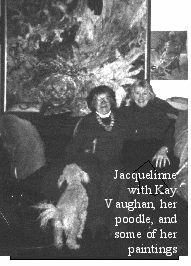
Jacquelinne with dog
Jacquelinne enjoys animals.

I had one of the greatest compliments I ever had the summer I visited Alert Bay, British Columbia.

I had been teaching art to kids in Comox where my aged mother lived in an old folks' home. I loved working with the responsive children; they did superlative work and I could visit my mother every day. Besides that a group of young people in their early twenties, adventurous small town kids, visited me while I was working. They invited me to their "hippy" parties where they danced and smoked pot and sang. One of the girls made me a lovely red cloak with a green satin lining. It was a very nice summer. Rich.

My daughter and her two small children were spending the summer with close friends at Alert Bay which was further north and on an island off the east Coast of Vancouver Island. I had a phone call about the time my classes were over telling me I was needed at Alert Bay because my daughter had suddenly been taken very ill. I took a bus to Powell River where, as I remember, I had to take a boat to a Finnish fishing village where I would catch a small plane to Alert Bay. While I was sitting reading and waiting for my boat a small boy suddenly appeared right in front of me.

"Are you going to Alert Bay?" he asked. I told him I was. "Take me ?" he asked, and added "I am little but I am old. I am fifteen. My name is Danny."

He told me his family lived at Alert Bay and he needed to get home. I decided to take him. Shortly the boat came in and Danny and I found places to sit on long plank seats. I asked him where he had been away from home. He told me he had been in a detention center for delinquent children.

"Good Heavens, Danny," I said, "What on earth did you do that you were sent to the detention center?"

"B and E," he smilingly answered.

"What is B and E?" I asked.

And he answered, "Breaking and Entering."

"Good Heavens," I answered," Was it worth it?"

"Oh, yes," he eagerly replied. "They taught me how to fix cars. If I get to go back I am going to learn about planes."

At the Finnish fishing village, the name of which I cannot remember, Danny and I waited for the plane. When it came in, a bright yellow little job, a handful of passengers started to board. The cocky and friendly pilot came over to me and asked. "Where did you get the kid." I told him what I knew of Danny. The pilot said he would split Danny's fare with me.

It was on the short ride in the littel yellow airplane that I was given the great compliment.

"Who are you?" Danny asked me, and he went one more, "You are not white that is for sure. But who are you? And then his bright little face lit up, "Oh, I know, I know," he chuckled." You are Haida. Wait until I tell my mother a Haida lady brought me home."

totem pole drawing

Me, Haida? The Haida Indians live on their own set of Islands off Vancouver Island and they are the people who make the most wonderful of the totem poles. And they make huge ceremonial bowls and carved boats. They make what we have learned to accept as the best of all Indian carving and ornamentation. Their totem poles are world famous. I have never been on their islands and that is the one thing I want to do more than anything before I die. I shall do it.

I need to, don't you think? After all I was taken for a Haida woman by a wonderful Indian boy — Danny. Little but old. Canny. Able to survive. Someone who spoke as poets speak. When I had asked him when he had gone to the detention center he told me he did not actually know the date but it was oyster picking time.

Read More...

Wednesday, December 06, 2006

The Sledders

by Jacquelinne White

The Sledders

Read More...

Tuesday, November 28, 2006

A Life of War

by Jacquelinne White

Jacquelinne at home with two of her friends

My father lived through WW1. He was in the British trenches that famous Christmas when the Germans, in their own trenches only yards away, threw sausages over to the British and the British sent them back plum puddings. Daddy was one of the men who danced on no-man's-land that Christmas Eve. Young and beautiful German men and the young and beautiful Canadians and other British men danced together until each side was called back and told to continue trying to kill one another. My father lived long enough in the trenches to see the hands of the men they had buried in the walls fling off the dirt and stretch out those hands so their still- alive fellow soldiers could shake them going by and send them greetings. He lived through being buried alive for three days, buried under the earth piled up by a bursting bomb. His fellow soldiers found him when there was a "lull", still breathing, talking but not responding to them. Over and over he said," It is Wednesday to-day. It is Wednesday to-day." He had been buried on a Wednesday and tried to keep his sanity by repeating that sentence.

It was one of the first sentences I ever heard and only partially understood. My sisters were one and two years younger than I. We, too young to fully understand, realized Daddy sat down and gripped the arms of his chair when he was under stress. So when we were sad or disappointed we too sat in our chairs, our small chairs, grabbed the seat beneath our bottoms and repeated, "It is Wednesday to-day." We were of course corrected by the maids, our mother, and our much older siblings. When we were a little older and had been trained not express ourselves in that manner we would still hear Daddy so we would hit him on his hands or his knees and say, "No, Daddy. It is not Wednesday," and he would come out of his trance. We did that all through our childhood and our teens and our early twenties, until we left home, and even when we came back to visit we sometimes brought him back to the present by tapping him, stroking his head, being more gentle than we had been as children when we did not fully understand.

He "talked to himself," but it was not really talking to himself. He talked to Alfie. He always said the same thing. " Your mother is coming Alfie. It is going to be fine. Your mother is coming." I questioned him about that when I was perhaps three years old. We lived on a Cree Indian reserve in Saskatchewan. It was a short walk from our home to his office. The walk was on a narrow dirt path through a little poplar woods, beside a willow-rimmed pond, across a little meadow, over a style into the cow yard, across that yard and through a gate to his office in the middle of another meadow. I used to follow, every chance I got, padding along silently behind him, listening to him. I always turned back just before the style because I was afraid of the milling cows. One day when we were almost to the style I startled him by asking, " Who is Alfie?" We sat down on the steps of the style and he told me about Alfie. Nothing he told me made much sense to me but I pondered and I remembered. Before he started he said something about it not being necessary to tell Momma. We were used to having secrets from our mother and we understood why. There might be trouble if she knew our secrets. He then told me about Alfie. He said, "Jacquelinne, he was only sixteen years old. He was wounded and going to die and he kept calling for his mother. He was only sixteen. I thought it would comfort him to think his mother was coming. He was only sixteen when he died, Jacquelinne."

At the age of three or four I could not comprehend sixteen years. Sixteen seemed very very old, maybe about the same as ninety. I think I must have been in my middle teens before I properly understood. Alfie had slipped by the recruiters and had been sent to the trenches with men eighteen years old.

It seems to me I have always known war. I was nineteen in September 1939. Still young when Korea came along. Not old during the Vietnam war, fearful they would draft my grandson in the Gulf War. Now there is war again and others living through the horrors and even worse than the generations before them, unspeakable though those wars were.

Thousands and thousands all over the world are marching and protesting but I also hear people saying, " Turn off the news. Do not think about it. We cannot do anything so why think about it." I have no response for them. I do not criticize them. But it is in me to remember and to cry out. I need to paint it, to write it as artists and writers for all time have done. Guernica. On two magazine covers, The New Yorker and Harpers. Picasso's Guernica. We remember the Spanish artist of 200 hundred years ago who was so explicit in what war looked like. I am so grieved I cannot bring up his name. Most of you know his name I am sure and I too shall in a few moments. I am too stunned to think clearly.

The man's name was Goya. Remember the woman with a bayonet, with a baby in her arms. Remember her victim.


Daddy told another tale: He was sitting, alone, under the only tree left in what had been a small wood. The tree was shorn of leaves, blasted off by the same ammunition that had felled the other trees. It was moonlight. A nightingale flew over and dropped onto one of few branches left on the tree, threw back its head and sang to him.

"Daddy," from a painting by Jacquelline

Read More...

Tuesday, October 10, 2006

Talking about Art

This discussion derived from a series of e-mails not originally intended for publication.

by Jacquelinne White

I have little interest in commercial art. I am not the least impressed by sales. Some of the world's most idiotic artists make the most money. You do not have to look very far to find an example. The one that comes to mind right off is the man Robert Kincaid. He has advertized widely in many magazines. You may remember having seen his ads. "Cute" little houses with the lights on inside making a glow, for instance, on the snow surrounding the villages and homes.

There are of course ways of critiqueing a work of art on a technical level but one rarely sees that sort of thing in professional reviews. Learning the technical side of art is done at the student level. Once in a long while a reviewer will comment on the lack of good technique because, perhaps, the

paint is flaking off which indicates the painter was sloppy about preparation, or did not know how to prepare his canvas or whatever. Comments on that sort of thing are very rare. I mean comments in reviews in newspapers or professional journals.

It is almost impossible for me to reply to comments from people whose ideas about art are very primitive. I am a person with almost no education in the sciences and might well make foolish comments or ask naive questions about matters of science. It is not a matter of being able to judge on "technichal criteria." Again I mention it is most unlikely that a professional reviewer will get into technical areas when commenting on a work of art.

One is free, of course, to choose what one wishes. But you will never have a good hold on what makes a good work of art unless or until you spend some time studying the field. Your ideas of how professionals in the arts see works of art would be so far and away from the truth that I would have no answer for your comments. Artists, of all ilk, spend years of hard work learning their craft. I cannot begin to impart in a short article with just a few words what it took me years of hard work to absorb.

One thing is clear however. You cannot even begin to understand what art is about if your approach is based on what you have learned in order to become a scientist, engineer, or a computer professional. What is rightfully valued in computer training might well be devalued when it comes to training and education in the arts. It would be most difficult, I assume, for one to realize the extent to which intuition is used by artists; spiritual things are dealt with, secrets, suspicians, conflicts, the unkown. The unknown can flag us on to further experimentation with sometimes glimpses of enormous beauty and even comfort and sometimes glimpses of Hell. We deal and work with the nebulous. We present our very awe and gigantic puzzlement.

You are free, naturally, to like what you like. You will choose according to your ability to experience what is in front of you. You might keep in mind that that ability can be one that has had little chance to develop or it can be an ability that is honed to appreciate works of art in great depth.

It is like trying to understand philosophy when the teacher is speaking in a language totally foreign to the listener. Within language are cultural refrences, references that the native speakers find obvious, so obvious that they do not hesitate for a moment while they, and their audience, absorb the extra meaning that is being injected. The spontaneous injection of ideas might be as slight a thing as the use of a single word, or a phrase. It might colour the ideas being presented rather like a wash of colour spread over part of a painting.

I feel I must tell you that I have found the people in science I have met, and even become friends with, have made my life far richer than it was before. There is ample room for all of us. And in the end we all seek the same truth. We just go about it in different ways. We find different facets too.

The descriptions "important art" and "good art" are in general not in my vocabulary. I become bored with conversations dealing with these terms.

I am not used to writing or speaking about art with people who have little knowledge about art and do not intend to learn more about it. Personally I am on a continuous search, have been all my life, and I have not yet found all the answers. In fact, in spite of my industry, I suspect I have been able to uncover only a small fraction of the ideas concerning art waiting out there for reaping.

I have often worked with people who have no background to speak of in the arts but in almost all cases those people were curious, wanted to learn, were willing to spend time with the work of world renouned geniuses, with the work of scholars in the field. It has been one of the great delights of my life to not only work with children but with people who teach children. Children frequently have less inhibitions and it is an adventure working with them. One never knows what will appear, what questions will be asked, problems solved.

Often the creative art work of so-called primitive peoples is highly sophisticated. Remember the work from Africa, from the Haida Indians of British Columbia, just for starters. Think of the masks or the totam poles. There are thousands and thousands more. It seems to me that the notion of aesthetics is evident in societies long before those societies put their minds to sophisticated and complex scientific adventures. They dealt with what was immediate including their architecture which included sod houses, straw shelters, homes made of animal hides such as the native people of this continent developed. Inventions of long ago are still being used. Note the conical tepees. Religion and cultural myths are frequently "illustrated" in their homes. I cannot think of a better word but I think there must be one.

The questions I have frequently encountered in the High IQ organizations are naïve, those one commonly hears, especially in the USA in my experience. The general population of the old countries, in Asia, in Europe, in Africa, in the Andes etc. somehow seem to have absorbed aesthetics from childhood, from experience with works of art around their homes, their villages, the holy places. I am no longer familiar with what goes on in Canada but my childhood and youth there were bleak when it came to the arts with the exception of music. We had great music festivals and I was much involved from an early age. First class adjudicaters were brought in even in remote places such as my home in an isolated village in the far north of Manitoba. It was a town that had a big lumber mill and which was also the "home" for trappers. It was an honest to God rough and tumble frontier town in my youth and I imagine it has not changed much. But they paid for Canada's best when it came to getting music adjudicaters.

Learning to be an artist was not easy for me, much as I wanted to learn. I had no background to speak of in aesthetics when it came to painting and sculpture etc.. But I started in to dig and learn when I started back to school when I was 34 years old. I was most fortunate in my teachers. We had a number who were world re-nouned even though the art school was small. I had also the stimulation of working alongside of students half my age. I still see and hear from many of them. Quite a number have become well known and respected as leading artists of this time.

Read More...