Monday, December 17, 2007

The Candidate

by Paul Maxim


Mario Biaggi

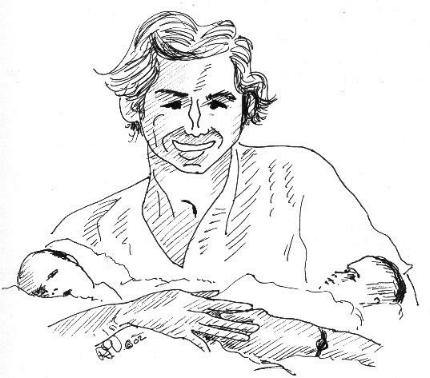
Republican Congressman MARIO BIAGGI (a former cop), running for mayor of New York City on a Law and Order platform, climaxed his campaign by telling a group of Harlem democratic voters (with apparent sincerity) "Bless your black hearts!"

PS.: Yes, this really happened...
P.P.S.: No, he didn't win...
P.P.P.S.: Long live democracy!

Read More...

Thursday, May 10, 2007

Institutionalized, Inclusive Grievance Pathways (IIGPs)

Carole Fotino headshot by Carole Fotino

Today’s violence is the result of those experiencing real and relative deprivations examining the costs and the benefits of each of their options toward resolving the situation and discovering that the least costly is violence – in the form of either war or terrorism determined by the size and reach of the “foe.” These decision makers are rational. They are weighing their costs and their benefits and they are making choices that make sense.

Relative Expense

They make sense because less costly alternative means for restoring balance are absent. When there are in place at all levels, non-violent and inclusive pathways for resolving grievances, accessible by those experiencing deprivations of all varieties, the cost of using these pathways will be less than the costs involved in the current, violent pathway – often the sole available pathway to change. By increasing the relative cost of violence, we decrease the likelihood of its usage.

Autonomy

The Peace Institute is making an extensive examination of autonomy movements around the world. Preliminary data suggests that what is really sought after in these situations is freedom from oppression, and voice – inclusive participation in representative systems. Interests that can be better gained without autonomy through IIGPs.

Initiatives

This program includes the dual components of institutional work. While doing the innovative, original and comprehensive research into the pathways, autonomy, and related subjects, we also move forward with active programming of initiatives to implement IIGPs around the world.

For more information, see the Peace Institute of the Rockies web site.

Read More...

Friday, April 27, 2007

Strategic Decision Making Program

Carole Fotino headshot by Carole Fotino

Carole Fotino is director of the Institute for Decision Making & The Peace Institute of the Rockies. She met with the US State Department in Washington DC in April, and as a result they are planning to include the Secretary's Policy Planning in the organization's forward movement in a way that is yet to be determined. Secretary's Policy Planning is the group working with US Secretary of State The Honorable Condoleezza Rice to create the foreign policy decisions of her office.

The Strategic Decision Making Program - a.k.a. "Costing Latent Conflict" - is a simple idea really. Events that appear unrelated through time or space (partitioning and future genocides are an example) are actually organically connected, that connection we label as Latent Conflict and the costs of the second event need to be included in the decision making process (through the cost/benefit analysis) prior to the first event. It's not unlike the beginning of the environmental movement in which the costs of later environmental status need to be included in the processes that created it. Though it is a simple idea, two simple and connected ideas really, it is often not perceived as so by those with whom I speak! To me it seems almost commonsensical and like something that should have occurred to us many decades ago but, is really rather cutting edge in the world instead.

By the way, Organizationally, I represent the Inst. for Strategic Decision Making when I'm in DC and with corporations (the two target audiences for this program) because that's more akin to the lingo they understand. It is however a Doing-Business-As name for the Peace Institute and it and the program that goes with it are only one of 8 programs with innovative approaches to the establishment of peace. What we say is that the Peace Institute develops and strengthens the social institutions that will allow for the non-violent resolution of conflicts internal to and between nations. Terrorism, IIGPs (Institutionalized, Inclusive, Grievance Pathways at all levels,) and S.A.W. (Soldiers Against War) are three of the other programs we have as well. Descriptions of the other related programs will be described in separate postings to this blog; they may help to clarify the situation further.

The ideas (Costing Latent Conflict) have been nominated for a Breakthrough award and, I'm told, a possible fellowship.

(Anyone interested in assisting with this effort should contact the web administrator who will inform Carole so that she may contact them.)

Read More...

Wednesday, April 18, 2007

Still Happy to Be American: a Kurt Vonnegut Tribute

"Veritas Our president is a Christian? So was Adolf Hitler. What can be said to our young people, now that psychopathic personalities, which is to say persons without consciences, without senses of pity or shame, have taken all the money in the treasuries of our government and corporations, and made it all their own?"
&mdash Kurt Vonnegut

Fred Vaughan headshot by Fred Vaughan

I was born here, as were all of the previous five generations in my family. I believe that every one of my progenitors considered themselves most fortunate to be American. I do. Of course one must assume that they were indeed proud to be Americans as well, just as I had been until Election 2000. The illusion of democratic difference died then, and the corpse is beginning to stink. Like Kurt Vonnegut I have become quite a disillusioned old curmudgeon.

There is still much to be happy for. Our standard of living is still high - not the highest in the world anymore, but still high. We still have constitutional rights - although nowhere near as many as we had a very few years ago. We still have freedom of speech - more or less - as this will hopefully demonstrate, but nowhere near as much as we once had, and our "freedom of the press" has become freedom of the administration and its corporate backers to propagandize the populace.

But I am ashamed of the rape of democracy by organized voter fraud, manipulated propaganda, and the projection of lies such as, "Why vote, they're all equally bad!" Anyone who believes that has not really thought about it. Would Al Gore have lied to get us into a stupid and unconscionable war with 'collateral damage' running to a million lives? Would John Kerry? Would either of those candidates who by almost any valid accounting actually won the last two elections have condoned torture or systematic destruction of the constitution? Would they have unconscionably provided tax cuts to the top 1% which depleted the treasury at a time when hundreds of billions were being appropriated for a war initiated because of administration lies just to give the excuse of our not having enough resources to care for our sick, our poor, our aged? Would they have ignored the victims of Katrina? Would they have ignored global warming? Would they have sold our freedom of the press to our largest corporations for campaign donations who then goad us into the wars that maintain their "World Trade"?

Today we still mourn the deaths of those students and faculty massacred at Virginia Tech. Our president says we will get over it — without gun control legislation just as we do the other 30,000 fatalities from gun violence in the United States each year! Just as he thinks we will get over Katrina — even without there having been a conscionable FEMA response. In the last week 30 Americans died in Iraq, and I suppose we will get over them too just as we have gotten over the 3,000 before them. We will get over the 200 innocent lives lost to collateral damage by bombs in Baghdad today just as we have gotten over the million before them — collateral damage to Bush's "just cause".

Here is a tribute to Kurt Vonnegut who had the courage to say it how it is:

Cat's cradle figure
His book is "Cat's cradle", not "Ice Nine"!
Ice Nine sigh
The Way the World Ends!

Read More...

Monday, December 04, 2006

Assessing US (Bush Administration) Assessments - Part 1

Robert Seitz headshot by Bob Seitz

Three-and-a-half years ago (May 2003) several of us contributed articles relating to the just-completed investment of Iraq. It might be interesting to assess where those interpretations stand today. But first, a word of preamble… (If you're au courant regarding the "Project for the New American Century," you might want to skim this next- page-and-a-half, which re-plows furrowed ground.)

During the 44 years of the "Cold War" (1947-1991), the U. S., as the paraclete of the "Free World", acted both overtly (The Korean War, the Viet Nam War) and covertly (The Bay of Pigs, the anti-Soviet arming of the Afghan mujahideen) to thwart the spread of communism. During that period, the U. S. would have obeyed no rules but its own, so it may have come naturally that in 1992, with U. S. foreign policy "drifting", the U. S. Secretary of Defense, Dick Cheney, and two of his employees, Dr. Paul Wolfowitz and Lewis Libby, came up with their audacious, idealistic, and visionary plan, "Defense Policy Guidance". To recap: "Defense Policy Guidance" proposed that the U. S. would

(1) seek to remain the world's sole surviving superpower, allowing no other country to grow strong enough to challenge our superpower status;

(2) install representative republics throughout the world (which would presumably then be friendly to us); and

(3) become the world's policeman, beefing up our defense budget, and creating a set of permanent "forward operating bases" around the world.

A draft copy of "Defense Guidance Policy" was leaked to the New York Times, whereupon Senator Joseph Biden, Secretary of State James Baker, and Foreign Policy Advisor Zbigniew Brzezinski prevailed upon SecDef Dick Cheney to withdraw the plan (which he did). In their eyes, the plan called for global control.

In 1997, the plan's authors updated and re-issued the plan under the rubric "Project for the New American Century" (PNAC). The PNAC sets forth the "Main military missions" necessary to "preserve Pax Americana" and a "unipolar 21st century". By now, the players had expanded to include Richard Armitage, Ellen Bork (wife of unconfirmed Supreme Court nominee, Robert Bork), Jeb Bush, Dick Cheney, Zahmay Khalilzad (our current ambassador to Iraq), Lewis Libby, Richard Perle, Donald Rumsfeld, and Paul Wolfowitz.

The men and women who supported this concept considered themselves to be "realistic idealists", shooting for a comity of independent nations in which the United States would be assured of safe haven. Their lodestar (which, I guess, would also be my own) was that democratic governments (insuring individual rights that protect the minority from the majority) are what the world wants and needs. They cited the paradigm of the conversion of Germany and Japan to democracies after World War II, and Reagan's tough stance vis-à-vis the U. S. S. R. that led to the dissolution of the Soviet Union, as examples of successful republic-incubation interventions.

In 1998, following "perceived Iraqi unwillingness to co-operate with UN inspectors", several members of the group wrote President Clinton, asking him to invade Iraq and finish the job of removing Saddam Hussein from power. During the 1991Gulf War, the reason given by Dick Cheney for not continuing into Baghdad and deposing Saddam was that Saddam was holding together the Shi'ites, the Sunnis, and the Kurds, at gunpoint in an effort to weld together a modern, secular nation. Also, Iraq was a counterweight to oil-rich Iran. If Saddam were removed, it wasn't clear what would happen (though it's clear enough by now).

As you probably know, Iraq consists of the autonomous, peaceful, prosperous Kurdish enclave Kurdistan (with its own flag and government) in the oil-rich north, an oil-poor Sunni area in the middle, and an oil-rich Shi'ite demesne in the south. And as you also probably know, the Shi'ites are the underprivileged 10% minority in the Arab world except in Iran, where they are dominant"¦ one people divided by a common faith. Saddam Hussein was a Sunni, and under him, the Sunni Iraqi minority played the wicked stepmother to the Shi'ite's Cinderella. But now that the Sunnis and the Shi'ites are voting blocs in a republic where the Shi'ites hold a 2:1 majority, the tables are turned.

What you might not know is what I learned a few minutes ago: that Iraq is a actually patchwork quilt of intermingled Sunnis, Shi'ites, and Kurds along the general axis of the Tigris-Euphrates river, and that it's in this half of Iraq that the internecine warfare is taking place.

You're left wondering what became of those insights when the U. S. invaded Iraq in 2003. It doesn't take a rocket scientist to figure out what would happen if the Sunnis and the Shi'ites were given an opportunity to even old scores (especially if there were agents provocateur to drop seed crystals into this steaming brew). Nor does it take a >180 IQ to deduce what advantages might accrue to Iran if Iraq were eliminated as the chess piece holding Iran in check. With its oil wealth, Iran has been infiltrating Syria, converting Syrian Sunnis to Shi'ites. Tiny Jordan and Lebanon would be pawns in this game. Iraq's Shi'ite population might be expected to fit in naturally with Iran's Shi'ite population. Although Iran doesn't seem to want to open that Pandora's Box, might Iran offer the Iraqi Kurds an expanded Kurdistan? Could Iran convert some of the oil-poor Sunnis to Shi'ites in Iraq as it has in Syria? On the other hand, both Iran and Syria are concerned that the fratricide between the Iraqi Sunnis and the Iraqi Shi'ites might spill over into their lands.

Given the most favorable outcome, Iran might become the dominant regional player, with the next firewall being Israel.

A recent article cites the labeling of Iran and Syria as an "axis of evil" as one of President Bush' five mistakes. That statement, combined with the invasion of Iraq, contributed to a shift during the elections two years ago in Iran from a moderating government to its current right-wing regime. (A similar shift took place in Pakistan in 2003, where there was a seismic shift from a secular and moderate parliament to an Islamic majority.)


But back to the plot. During the 1990's, the drafters of the PNAC crafted a potent political machine, appealing to evangelical Christian, to defense contractors, and to industry in general.

Just before the 2000 election, the PNACers issued an update entitled, Rebuilding America's Defenses: Strategies, Forces and Resources for a New Century, further detailing their plans if elected. The plan observed that what was needed was another Pearl Harbor to motivate the American public to support the PNAC and a military buildup.

Between 1992 and 2000, Saddam Hussein orchestrated an assassination attempt upon ex-President Herbert Bush. I've wondered what role that might have played in the Bushes' backing of the invasion of Iraq. (Perhaps different players had different motivations.)

During the 2000 election, as quietly as falling snow, a political cabal with its own agenda hijacked the Republican Party and then the U. S. agenda, all unbeknownst to us, the people. Whether we favor the PNAC plan or whether we don't, it seems to me that this coup d'état revealed how easily our government can be subverted. And for me, this is shocking. This may have happened before, politics as usual, without most of us being aware of it, but that doesn't make it any less ominous.

To anticipate the rest of this assessment of our assessments, everything we collectively published in 2003 still seems as relevant as it did then. The difference is that by now, over half the U. S. public agrees with us, whereas then, it probably didn't. By now, it's abundantly clear that the invasion of Iraq had been planned well before 9/11, and had everything to do with the PNAC.

One major problem with the PNAC is that for all intents and purposes, it was implemented on the sly. Although, to their credit, the PNAC proponents made no secret of their plans, and have published them on the http://www.newamericancentury.org/ website, most people are still unaware that it exists, let alone that it has formed the playbook for our current administration. Consequently, it came as a sinister surprise to those of us who had to "learn it on the street" rather than hearing from more conventional sources.

And this raises a mystery: why have there been no illuminations of the "Project for the New American Century" in the media or on the part of politicians? By now, references to America's new imperialism and to the "neocons" are legion, but they all assume that the reader is conversant with these topics. In my experience, these references whiz right by the average reader. So where was our immune system: the media?

The problem that struck me most, first, about this "audacious, idealistic, and visionary plan" is the effect it would seem to me to have had upon foreign leaders. Even if the PNAC's idealistic leaders were as pure as the driven snow, what would the condottiere who implemented the plan do with it? Would they say to the idealists, "Thank you very much for assembling these reins of power. Now we'll take over. You run along and play." What would happen in 20 years? 50 years? Would foreign leaders want to kiss the ring of the almighty United States? Who would control this juggernaut? Where are the checks and balances? Once you build and sell the nation such a political machine, it becomes an attractive target for whoever can commandeer it. "If you build it, they will come."

New Arms Races?

In my view, this bold and visionary plan would trigger (and has triggered) a new international arms race. Given CIA renditions, assassinations (President Bush reinstated CIA assassination policies in 2005 after a 32-year hiatus), U. S. armed interventions, and now, full-scale invasions in violation of international law, you wonder if some might be so uncouth as to consider - unfairly, I'm sure - the U. S. to be the world's leading terrorist nation. Surely not!

The abrogation of the SALT II Treaty, coupled with U. S. announcements that we would develop tactical nuclear weapons and nuclear "bunker busters", and that we plan to use nuclear weapons against third-world nations that displease us must have triggered a nuclear arms race. Added to that is our shift from a belligerent to an accommodative stance once we found out that North Korea had nuclear weapons, our endorsement and nuclear partnership with India when we perceived it to be in our interests to boost India against China, and our whole-hearted endorsement of Israel's nuclear weapons developed in violation of the Nuclear Non-Proliferation Treaty, and you can see why a nuclear arms race has developed among some third-world countries.

Nuclear Armageddon?

In the meantime, we are still living half-an-hour away from nuclear Armageddon. In 1991, when the Cold War ended, I heaved a sigh of relief, and decided it was time to forget about mutual assured destruction. But in point of fact, the threat is still there, and in some ways, more sinister than it was during the Cold War. Russia has an alleged 8,200 nuclear warheads, with about 950 ICBM's to deliver them. The (plausible?) perception of the U. S. as a rogue nation must have caused the Russians to crank back into their ICBMs the coordinates of U. S. cities and missile farms. There are fewer than 300 cities in North America with populations of 50,000 or more, all of which are said to be targets for nuclear warheads. At the same time, the U. S. has an estimated 7,000 nuclear warheads, with some of them loaded onto nuclear submarines, presumably ready to vaporize Russian targets. It has been estimated that 1,000 nuclear warheads exploded more or less simultaneously would start enough fires and loft enough dust into the atmosphere to bring on a nuclear winter, destroying civilization, and perhaps, all higher life forms on this planet. I'm under the impression that there are nuclear weapons and missile delivery systems in some of the former Soviet nations such as the Ukraine(?) and Kazakhstan(?) as well. Further, Russian early warning systems are allegedly becoming old and rickety. I've read the claim that in 1996, Norway launched an Earth observation satellite that initiated a Russian red alert. Boris Yeltsin was said to have been 10 seconds away from a retaliatory strike when the all-clear signal was sounded. In addition, there has been a leakage of nuclear technology from the lightly funded, lightly guarded arsenals of former Soviet satrapies.

A popular speculative topic in conjunction with the search for extraterrestrial intelligence is the Fermi Paradox: if other intelligent races exist in our galaxy, where are they? If I look ahead, it would appear that it will become ever easier and cheaper to destroy higher life forms on our planet, leading, in the limit, to a time when even minor-league fringe groups could annihilate humanity. Applying this to the galaxy as a whole, we might conclude that technological civilizations self-destruct when they develop the capability to readily do so.

Have a nice day!

Does Democracy Come Out of the Muzzle of a Gun?

Other concerns are that the "Project for the New American Century" delivers democracy at gunpoint. While the targets of this "gunpoint diplomacy" are to be repressive regimes and dictatorships, and the beneficiaries the people whom they repress, it's not clear that the populations themselves will trust democracies imposed by a Western Christian nation like the United States. Invading one's homeland to install a new and unfamiliar government from without can trigger strong territorial imperatives.

Exporting Democracy Even As We Are Perceived To Be Abandoning It At Home

Should I mention the incongruity of the U. S.' exportation of democracy and human rights to other nations when we are perceived to be curtailing our own democratic institutions and human rights? Our own Supreme Court, after the appointment of the most conservative Justices our Republican-controlled Congress would accept, has ruled several of the abridgements of detainees' rights to be unconstitutional.

The Meanings of "Democracy"

For op-ed writers in Lahore's Friday Times, US-imposed "democracy" means Walmart, MacDonalds, single-parent families, drug pushers, gay marriage, and evangelical Christian missionaries. Third-world nations tend to be old-fashioned, and aren't eager to enjoy those modern liberties.

The Naïveté of the Project for the New American Century

This plan for a "Pax Americana" seems to me to be dangerously naive. The concept of the U. S. becoming the superhero who installs democracies around the world against the will of existing governments assumes that the U. S. has the capability to do this. Modern nations would seem to derive their powers not just from military supremacy but also (and perhaps, more importantly) from such diverse strengths as economics, education, personal probity, and an equitable distribution of wealth. I have the impression that the PNACers are approaching this as power politicians who are taking for granted all the other capabilities that are needed for such a grand vision. "When your only tool is a hammer, everything looks like a nail." Poly Sci. types would think in their idiosyncratic way, economists in another way, and sociologists in yet another.

Seeking Guidance in the Rear-View Mirror

One recent article I read extolled the Roman extirpation of Carthage as a scorched-earth model for present-day warfare, and I've already mentioned the members of the Bush Administration who suggested that Rome didn't do so badly - that maybe a New Rome was the proper future for the U. S. That would be fine if we're willing to return to the technology, and particularly to the military technology of the 2nd century B. C. Otherwise, forget it. We live in era of potential self-destruction as a species (a process that may already be in train if runaway global warming takes place). This is the 21st century, and some strategies that were permissible for our grandfathers are no longer permissible for us (or at least, that's what I think).

Semantics - The Tyranny of Words

As I sit here writing this, I'm struck with the fuzziness of the meanings of the words I'm bandying about. When we talk about newtons, meters, and joules, we can communicate unambiguously, but when we use the word "democracy", there's no such precision. Does "democracy" refer to an Athenian democracy in which all decisions are made by majority vote? If so, modern nations are orders of magnitude too large to permit such governing machinery. I suppose, if I thought about it, I might define "democracy" to mean governments in which the public elects a congress or parliament which then promulgates laws intended for the common good. Democracies also typically have an executive branch and a judicial branch, providing for a separation of powers. The citizens of the state are considered to be parties to a binding contract with the state that assures them of certain legal protections from one another, and from the powers of the state. Or at least, that's how I might define a democracy. Like most words, I've learned my definition of "democracy" from context rather than by looking it up in a dictionary. But you might define it slightly differently, and therein lies the rub: when I talk about "democracy", I have one concept in mind, and when you talk about "democracy", you might think in terms of a somewhat different concept. Meanwhile, neither of us knows that the other isn't quite on the same wavelength. And so it goes. For example, when I use the word "renditions" above, I'm using a term that I've inferred from context, and have never looked up in a dictionary. I interpret it to mean a kidnapping by the CIA, followed by imprisonment in a secret detention center (concentration camp?) somewhere around the world. ("Rendition" is evidently a euphemism coined by the CIA because it sounds better than "kidnapping" and sneaking the victim out of the country", which is what it really is). But this particular definition of "rendition" is in this useage another application of the term that is too new to appear in my dictionaries, and I really don't have a precise definition for it, much less a commonly defined definition upon which we can all agree.

Labels - the Tyranny of Abstractions

One of the taproots of our human powers is our ability to generate and manipulate abstractions. We attach labels to vastly complicated and variegated entities, and then proceed to manipulate these symbols as though they truly represented their referents. The ultimate abstraction might be "the universe". For example, I label someone "Sunni" or "Shi'ite", and then proceed to operate as though there were two categories: "Sunni" and "Shi'ite". In reality, these are usually human beings who are trying to live their lives caring for their families, and who can just as easily be "Sunni atheists" as "Sunni zealots"… like my brother-in-law, who says he's a Methodist atheist. In short, there's a spectrum of religious involvement. Most people don't lead lives that are primarily devoted to religion, and labeling someone this way may shift emphasis from the important issues in their lives to something that's incidental. Labeling someone Jewish tells us absolutely nothing about what that person is like, or about what's important to, or about him or her.

Of course, this problem arises with everything I'm writing here: I'm attaching labels such as "Pax Americana" to something complex and variegated whose definition I've acquired through osmosis.

I think the same thing may have happened with the PNACers. They want to introduce "democracy" around the globe. But this entails premeditated invasions and the wholesale killing of innocent "enemies" - other people's children, along with their family members. Thanks to the power of abstraction, chicken hawks can order the maiming and death of innocent children without ever having to listen to their screams. (Hey, you've got to accept some collateral damage to impose a new political order.) Now, we're faced with the deaths of 160,000, or 2/3rds of a million Iraqis (take your pick) in the name of bringing Western democracy to that country. The idea that the survivors of this carnage will view the United States with gratitude and acceptance is… well, fill in the blank____.

Iraq has become a "darkling plain where ignorant armies clash by night" (…"nor all the Prez' horses nor all the Prez' men can put Humpty-Dumpty together again.").

Many of the prime movers who formulated the "Project for the New American Century", such as Richard Perle, have now disavowed the invasion of Iraq because of the wonderfully incompetent way that the Bush Administration has implemented it. But I'm wondering if it wasn't the invasion of Iraq itself that has led us into our quagmire, in keeping with the 1991 decision to avoid investing Baghdad. I guess historians will sort this out.

I think that the hawks on both sides who try to egg on the rest of us to fight each other ought to be forced to fight each other in the flesh. It would be interesting to see just how eager they themselves would be if they had to hazard their own lives. (You may have noticed that the Islamic leaders who are exhorting young Muslims to sacrifice themselves as suicide bombers so that they can go immediately to Paradise, aren't volunteering as suicide bombers themselves. If the rewards are all that great, why aren't the leaders leading the way?)

Depth and Complexity of Knowledge

I have just read an article observing that the incoming Speaker of the House, Nancy Pelosi, is going to have to engage a different group of political consultants now that she has become the Speaker of the House. These "handlers" will insure that she doesn't make the mistake she did in backing Jack Murtha to be the House majority leader. Apparently, politics has become so complex that politicians have to hire political experts to perform the jobs for which they were hired.

Furthermore, I realize that in dealing with any issue such as the war in Iraq or the relationship between the Israelis and the Palestinians, there are depths and subtleties of which I haven't a hint. Those of us who are brighter than average may know more than average, but we're still babes in the woods when it comes to expertise in all fields. (It may take some future AI to pull together all the perspectives.)

After the Year-2000 Presidential Election…

My reason for reviewing this early post-election history is to underscore the wild and, as we now know, incompetent steps taken by the new Bush Administration not just in foreign policy but in other areas of government as well.

After the Supreme Court had ruled in favor of President Bush on the Florida election, I said to myself that it was time to support our new president. After all, the vote was very close. The country had exercised the legal apparatus designed to resolve such close elections, and it was time to consider the decision of the referee to be final (though it was a bit disconcerting to read that business leaders were staging a once-in-a-lifetime blowout to celebrate this coming era of corporate fiscal unaccountability).

Among of the first developments after the inauguration of our new president were news releases out of Washington warning of the growing military threat from China. China? Maybe some day there would be a military threat from China, but you had to be pretty hard up for enemies to begin grooming China for the role.

Then in February 2001 President Bush announced that we needed to subsidize the construction of coal-fired electrical power stations because of our energy crisis. Energy crisis? There had been brownouts in California during the summer of 2000, but they were alleged to be a result of mismanagement. (It later transpired that they were engineered by Enron to jack up the prices of Enron's electricity.)

Next, President Bush cut the Department of Energy's solar research budget in half five months into the fiscal year! Part of their money must already have been spent. It must have decimated them.

Following this, President Bush rejected the Kyoto Treaty. (Please see the companion article "Global Warming Update" posted earlier.) He announced that this was because it would cost U. S. industry extra money to implement Kyoto. Here we are, one of the richest nations on Earth. We helped craft the Kyoto Treaty, and we expected third-world nations to sign and implement it, but we weren't willing to participate because the global corporations that contributed to our politicians' campaign funds were too greedy and short-sighted… short-sighted because there would be a burgeoning global market for renewable energy equipment.

After that, he renounced the Strategic Arms Limitation Treaty II. I told myself that he must have access to the nation's leading experts to help guide him in these decisions and that there must have been cogent, hidden reasons why they deemed these moves to be wise. But then it occurred to me: it isn't only a matter of what hidden justifications the U. S. might have. What kind of messages was our government sending to the world? This should trigger (I thought) a nuclear arms proliferation race.

It was at that point that I went from mild unease to serious alarm.

In concert with these high-profile moves, the new administration was doing umbrage in divers and sundry other less-visible arenas such as environmental protection, SEC rules and regulations, giving oil companies drilling rights in our nature preserves, and allowing the consolidation of media outlets.

At first, the media seemed unresponsive to these derelictions, but by summer, 2001, they were on the scent.

Meanwhile, there were some alarming quotations coming from members of the new administration. One was the statement that, "We make our own realities here in this administration". Another a statement was that Rome didn't do so badly. Maybe we needed a modern-day Roman Empire. A third was that the policy manual for the new government was Nicolo Machiavelli's "The Prince".

And then came 9/11 and the War on Terror.

The first "War on… " was Lyndon Johnson's War on Poverty. I don't think it made a serious dent in poverty, but it must have been well-received politically because ten years later, President Nixon announced his "War on Cancer", followed by the Reagans' "War on Drugs".

Within an hour or two after the second plane had crashed into the World Trade Center, President Bush/Karl Rove announced that we would declare war on terror, and that it would probably last fifty years. President Bush then sought and got temporary wartime emergency powers to last for the next 50 years - in other words, a permanent suspension of our constitutional rights. (In 2051, are our grandchildren going to approach whoever is leading us then and say, "Please, sir, the War on Terror is over. May we have our constitutional rights back?")

(To be continued in a later posting)

Read More...

Friday, December 01, 2006

Global Warming Update

Bob Seitz headshot by Robert N. Seitz

Last January I ran off a shirttail calculation estimating the weight of carbon dioxide in the Earth's atmosphere (280 gigatonnes), and compared it with the weight of methane trapped in the world's permafrost (also 280 gigatonnes). While methane has 22 times the global warming effects of carbon dioxide, it has a half-life in the atmosphere of only about 8 years. If this outgassing of AlCan and Siberian tundras took place completely but slowly, it would release something like 280 gigatonnes of methane that would convert to CO2 over a period of decades. But what I didn't consider was the fact that a tonne (metric ton) of methane, with a molecular weight of 14, would oxidize to a little over three metric tones of CO2, with a molecular weight of 44. So the 280 gigatonnes of methane would become 880 gigatonnes of CO2, or about 3 times the 280 gigatonnes of CO2 in the Earth's atmosphere today. That's not good news. That would quadruple the amount of CO2 in the Earth's atmosphere. I also mentioned the lesser possibility that the methane clathrates ("methane ice" deposits at the bottom of the world's oceans contain about 10,000 gigatonnes of methane, and that would convert to about 31,500 gigatonnes of CO2, and that this is thought to have occurred during the Mesozoic/Cenozoic Thermal Maximum that killed off the dinosaurs about 55,000,000 years ago. That wouldn't be the best prognosis for humanity, but at least it didn't transform the world into a searing hell like Venus.

It's important to be aware that the outgassing of methane hasn't yet been included in existing climate simulations, or at least in the forecasts that we're hearing right now.

That was the good news. Now for the bad news.

It has just been announced that the rate of rise of atmospheric CO2 has more than 2.5-folded since 1990…. the fourth consecutive year of two-parts-per-million growth. Last year, 7.85 gigatonnes of CO2 was added to the atmosphere compared to 6.87 gigatonnes in 2000.

A month ago, several news sites reported that in the latest annual report on climate change, issued last spring, it was erroneously concluded that methane release into the atmosphere had slowed down. In fact, it has continued to increase, but this fact was learned too late to correct it in the report. Now, in a display of "media Alzheimer's disease" the same media are reporting the incorrect earlier message that the methane release rate has fallen.

In the meantime, the rate of methane release from Arctic permafrost is rapidly accelerating.

To clothe methane release rates in numbers, suppose that methane is being released at the rate of 0.1% a year. At that rate, it would take 1,000 years for all the world's permafrost to outgas. Since there's an estimated 280 billion tones of methane locked up in the world's tundras, 0.1% a year would translate into a release rate of 280 million tones of methane a year. Given that methane has 22 times the greenhouse effect of CO2, this rate of release would equate to about 6 gigatonnes of CO2a year in terms of greenhouse effects, or about 3/4that of last year's CO2release. (Note that after 8 years, half of the integrated total of 2.24 gigatonnes (= 1.12 gigatonnes) of methane released over the 8-year half-life of this atmospheric methane would have converted to 3.15/22 tonnes of CO2, raising the global CO2burden by 3.5 gigatonnes of CO2.in 8 years. This would still be small compared to the 64 gigatonnes of CO2 added to atmosphere from other sources. )

Clearly, even an outgassing rate of only 0.1% a year isn't happening yet, or the effects would be more evident. However, we might expect that the warmer the Arctic gets, the faster the permafrost will outgas.

What's so alarming about the outgassing of permafrost is the fact that it would be a case of global warming feeding upon itself. Although our burning of fossil fuels would have initiated this process, outgassing of methane could, possibly, continue to elevate CO2levels even if we cut our fossil fuels emissions to zero.

This last summer, for the first time, a passage opened up through the sea ice all the way to the North Pole. This was a fluke, but it appears to be a harbinger of things to come.

Kerry Williams has brought up an interesting point, and has buttressed his case with computations. His calculations indicate that climate change is coming on too rapidly to permit trees to migrate toward the poles as fast as the global-warming-induced changes in their habitats. This could lead to an ecological crisis in which oxygen renewal might take a hit.

My personal prognosis-one that I try not to think about-is that we will pass the "tipping point" if we haven't already passed it, at which runaway global warming occurs no matter what we do. Conservation can help us reduce our fossil fuel demands somewhat, but some fuel guzzlers like 18-wheel transfer trucks are probably already about as efficient as they can currently be made, and our civilization depends upon our ability to haul freight. Even if we can reduce our CO2output to some 20th-century level, CO2would continue to rise.

I suspect that sometime within the next decade, there's going to be panic in the streets over this. Venture capitalists are already pouring money into solar power startups. Semiconductor-grade silicon is currently a bottleneck in solar cell production, and the prices of solar cells have risen rather than fallen over the past two years, due in part to Germany's subsidization of solar power and to California's "million solar rooftops"program. In the meantime, solar technology is in a state of ferment. (The best investment plays might lie in supporting technologies such as batteries, power inverters, or mounting hardware.) Within ten years, we might have high-efficiency, low cost solar rooftops that are natural looking and are fashionably accepted within the neighborhood. Production of vehicle fuels might be another application of solar power. For countries that have extensive electrical grids, solar arrays may take hold in central power systems in sun-belt regions rather than in the form of distributed rooftop power.

Another promising area is battery research. Long-lived rechargeable batteries that store a kilowatt-hour per kilogram may be in the offing. These are being suggested for hybrid vehicles that can plug into the wall for recharging. (Some amateurs are beefing up the lead-acid batteries in their Priuses for short around-town jaunts on electric power only, with plug-in recharging back home.) A typical home uses about 40 kilowatt-hours of energy a day, although careful design can reduce that number. At that rate, 100 kilograms of batteries could probably provide for a household.

Wind power offers promise along coastlines and in mountainous areas.

Biodiesel generated from cellulose waste requires some further bioengineering of microbes, but that might become a way to generate vehicle fuels. (I suspect that some combination of ethanol and biodiesel generation may be the wave of the future rather than hydrogen fuel cells. We already have a century of experience and infrastructure in place for the internal combustion engine. But we'll see.)

Nuclear power is an immediate short-term solution to power requirements, but one would hope that we would step on the accelerator with respect to converting to alternate energy solutions, bypassing nuclear power. In any case, it will take years to build new nuclear power plants. Meanwhile, in spite of efforts to convert to alternate energy sources, China is planning to rely almost entirely on new coal-fired power plants for its burgeoning power goals. But I suspect that this plan may be overtaken by the "pani-in-the-streets"

If the "panic in the streets" scenario occurs at some future time, I could imagine southern property falling in value, and northern property values rising, as people try to relocate themselves in anticipation of rising temperatures. Commercial installations would be shifted northward, and residential acquisitions would follow. In North America, land along the northern Pacific coast, and in Canada and Alaska would seem to me to be especially valuable.

The UK science magazine, "New Scientist"has taking the unusual step of describing the well-funded global warming disinformation program that has been mounted by Exxon, General Motors, and Ford Motor Company-a campaign that is reminiscent of the disinformation programs financed by the tobacco and dairy industries that deliberately obfuscated the dangers of smoking and dairy products during the 60's and 70's..


Some Thumbnail Calculations

An object in interplanetary space will arrive at an equilibrium temperature at which the radiation power absorbed from the sun equals the radiation power re-radiated by the object. The total radiation power absorbed from the sun by a spherical "black body"(perfect absorber) is given by πr2 times the power per unit area. For a spherical black body in the vicinity of the Earth, the power absorbed from the sun is given by the solar constant = 1,370 watts/square meter. The power re-radiated back into space will be spread over the entire surface of the sphere = 4πr2. This means that the re-radiated power density will be exactly ¼th of the power density received from the sun, or 1,370/4 w/m2 = 342.5 w/m2. Then we can plug this number into the Stefan-Boltzmann equation, Power/m.2 = 5.67 X 10⁻⁸ T4, and solve for the equilibrium temperature at which the Earth re-radiates the same amount of power/m.2 it receives from the sun. The resulting black-body equilibrium temperature is 278.8º Kelvin or 5.65º Celsius or about 40 degrees Fahrenheit. In reality, there are many complications that muddy these waters. There is cloud cover, atmospheric convection, and uneven surface and cloud top temperatures, to name just three.

Dr. Angell de la Sierra has raised the question: if CO2blocks heat radiation from the ground, why doesn't it also block the incoming radiation from the sun? I believe that this asymmetry may arise because the radiation from the sun peaks at a wavelength of about ½ micron, whereas radiation emanating from the Earth peaks in the far infrared at a wavelength of about 10 microns. The atmosphere is transparent to visible and near-infrared radiation, whereas it is, perhaps, semi-opaque in the far infrared. Dr. de la Sierra also observed that the situation must be complicated. Convection patterns would play a role. If atmospheric CO2is semi-opaque to far-infrared radiation, it can do so either by reflecting it or by absorbing it. If it reflects far-infrared radiation, then it would tend to re-radiate less radiant heat than the corresponding black body, and this would certainly have a warming effect. If atmospheric CO2is semi-opaque because it's a good absorber differential in the 5 to 15 micron range, then it would heat up. At the same time, the effective temperature of the radiating surface would tend to be low because the radiating surface would be high in the Earth's atmosphere, which is where convection enters the picture. Also (Dr. de la Sierra pointed out), atmospheric CO2might radiate from lower levels as well as higher levels, complicating the situation further.


If the Bush Administration's denial of the reality of global warming and deliberate inaction destroys humanity, it will be the greatest crime against humanity ever committed.

Time will tell.

Read More...

Wednesday, November 29, 2006

Bush Family Values Revisited

(Some Perspective on Family Values and the Law)

Fred Vaughan headshot by Fred Vaughan

PROLOGUE: This article was written in the early part of 2001 while I still chafed at the thought of democracy having been hoodwinked. I was waiting for an opportunity to submit the article to publication. But in those months history took over. That was before criticisms of G. W. Bush were considered tantamount to treason following the events of September 11. Continued unraveling of the evidence of unethical individuals financing far more than could be amassed by his opponent's more numerous supporters, the immediate payoffs in revised government policies worth many times what was expended, emboldened me again. On January 29, 2002 we had a news story that continued to shed the same perspective on Bush family values -- Noelle Bush (Brother Jeb's daughter) was arrested in Florida and released on drug charges. Today, November 28, 2006 the resident's girls are in the news again - this time in Argentina. So here's the original article:

Recently we have been privy to the juxtaposition of the time-honored concepts, family values and the law. These are concepts that have recently been promoted along with Christianity, as exclusively right wing Republican values, but, whether or not Jesus really was a Republican like Billy Graham, the Reverend Moon, or Bob Jones, let us begin by considering the plight of the "presidential" twins Jenna and Barbara Bush.

Look at what Fertility Drugs Can Do!
W babe Laura's shoulders
A New Daddy Bush and Twins A Little Overwhelmed

The venerable conservative William F. Buckley blames the Texas teenage alcohol use law for their current predicament. He says, "whatever one might intone about the relative responsibilities of children of public figures, still the offense for which they were arraigned is better commentary on the misbehavior of the law, than of the two violators of it." It is not clear, but one senses that "the misbehavior of the law" perceived by Mr. Buckley has been with regard to scooping up royalty along with the trash for which the law was clearly intended. The law's primary promoter and the one who actually signed the maligned legislation into law was none other than the right honorable right wing, bible-slapping family man Texas Governor George Dubya Bush who in so doing promoted himself as an adamant unstinting supporter of strong teen alcohol and drug laws. So in that spirit, Jenna has been the first offending teenager according to the Austin Times-Statesman who got her charge (her first one, that is) reduced to a lower class of offense than other teens: "Since September 1999 police have usually charged people using fake identification to buy alcohol with a more serious offense - a Class B violation of the Texas Transportation Code. Class B offenses typically result in arrest." During his campaign Bush advocated the teaching of "moral values" as the heart of raising children, so we must conclude that sidestepping the law must be one of those most "valued."

Bush twins
A Next Generation Picks Up The Torch -- "Watch Out!"

Earlier Frank Rich noted in the New York Times: "Had George W. Bush conducted a charm offensive when his daughter was hospitalized for an emergency appendectomy at Christmas - rather than fleeing for golf in Boca Grande, Fla. - would she be in open revolt now? By engaging in two underage-drinking ruses in one month - a 'crime' likely committed by more college students than not - Jenna Bush has made herself into the No. 1 poster child for the lack of compassion in her father's conservatism. It's Mr. Bush who signed the 1997 three-strikes, 'zero tolerance' Texas law that now puts her a margarita away from serving 180 days in jail."

Of course in Florida we have brother Jeb promoting a law rejecting the use of contraception by teens, espousing abstinence instead, although his own son has been arrested (one of the times!) for breaking and entering the apartment of a former girlfriend while intoxicated - presumably for cookies.

Nor was the earlier generation of Bushes a model of propriety. Jeb had his own appointed Playboy playmate just one office down the hall even though other more legitimate appointees (she had been appointed to a position in which she would rule in favor of her former employer) were assigned to other buildings. Then, of course, we have a brother for whom his father had to use presidential powers to rescue failed savings and loan escapades out of (correct me if I'm wrong) many billions of dollars in losses incurred by innocent people - why do we no longer hear of that brother and why do I worry about what he might be up to? Dubya's professed date of giving up booze and drugs seems to have coincided with Papa beginning his own campaign for the presidency for which naughty children could be construed as a liability. So that obviously made sense to Dubya, but it wasn't family values as traditionally held nor certainly the deep respect for the feelings of his wife Laura or their children as implied by the current resident of the White House. No. (Right wingman Dick Cheney out prioritizes Laura in living room photo ops!) The twins Jenna and Barbara were already well past the age when right and wrong and inebriated parents are beginning to crystallize into a life long family image, and well past the time that responsible parents have seen those obvious "thousand points of light." So clearly family values are secondary to political and economic necessity in his case, and in general that is the only logical lesson to be learned if family values are things to be learned from the Bushes at all.

W family
The Family Unit of Which Legend Is Made

And what about ethics? We have heard a lot from the Bush corner about the lies of "Slick Willie." As we all know, he was caught by a four year $70,000,000 fraudulently tax funded witch-hunt conducted by the right wing. And what was the ultimate offense secured illegally by intimidation? That the meaning of "having sex" was being restricted in a purist sense rather than to include any act conceivably involving the genitals that most (and all Republicans at this juncture of history) might include under that rubric. He was, in fact, impeached by a right-wing congress for that offense even though the out-of-wedlock generality of the offense about which the restriction applied was one of which virtually every one of his primary accusers and his predecessors in office were equally guilty - I'm not actually sure, of course, whether Senator Orin Hatch has ever had sex of any denomination so that claim may not unanimously apply. But the president's offense alone was escalated by bigots to the magnitude of treason since there were virtually no other flaws in the unprecedented economic and diplomatic successes of the Clinton administration nor in the reduction in the national debt, crime rates, welfare recipients, government costs, and outstanding records with regard to the many other measures of the health of a society which are now once again plummeting. Of course Republicans feigned disdain that Clinton had not served in Viet Nam (a failing in common with Cheney and Dubya and again, most all of his accusers) and that he had demurred with regard to having smoked "but not inhaled" marijuana. Recently resident Bush has signed a proclamation that would deny financial aid to any student who refuses to answer questions concerning his/her previous drug use record. This is the same demagogue who refused throughout his campaign to answer any question whatsoever concerning whether he himself had ever used drugs.

So let's compare Slick Willie's crimes with those of the Bush brothers if you will. We have a resident of the White House who has repeatedly hidden his arrest and drug use record in order to secure public office, who has broken Federal laws on several occasions to accrue tremendous profits on insider trading, and who with his friends has used political influence to accrue huge benefits at public expense and avoid criminal prosecution. And whereas the right-wing tittered about Clinton's campaign contributor's being granted a night in the president's spare bedroom at his place of residence - albeit called the "Lincoln Bedroom" in such cases - Dubya's backers were put at the helm commanding top secret US nuclear submarines resulting in the loss of innocent lives and international embarrassments of the first magnitude. In these first few but ever lengthening months that he has been in office,

Kenny Boy
ENRON Executive and long-time supporter of George Bush - "Kenny Boy" Lay

Dubya's primary backers have already gleaned hundreds of millions of dollars at public expense with favorable taxes and authorizations for exploitation of public resources with promises of much, much, more to come even while the economy is languishing on that account. His appointees are violating the public trust to their own benefit to the tune of hundreds of millions of dollars just as Cheney's companies amassed wealth by illegally dealing with foreign governments that were off limits to law abiding citizens. A precedent that Dubya's grandfather Preston set in dealing with his favored Nazi's long after such dealings had been outlawed for all US citizens. This does not even broach papa's pardon of Jeb's drug dealing affiliates. "Slick Willie" indeed!

Uncle Dick
"Uncle" Dick from Just Next Door…Well…er, Wyoming

Of course, Richard B. Cheney, the currently vacationing CEO of the friendly oil company Halliburton seems like one of the family when we see him sitting around the fireside chatting with his Texas neighbor - Oh, I'm sorry, they can't be neighbors, can they? Dick and Dubya have sworn that Dick resides in Wyoming, haven't they? Oh, well, small difference. Or when Dubya with much concern stubbornly defended that it wasn't a heart attack his cohort had suffered no matter what the doctors said. Anyway, it's hard to think of Dick as other than as all in the Family with his new artificial heartstrings. He is currently in a little hot water with the government accounting office for refusing to disclose the subject and costs of closed meetings with his fellow oil executives to establish US policies, but that too, what with concern for the heart problems that ensued, will blow over. On June 30, 2000, he appeared on ABC's "This Week", and said, "I had a policy that we wouldn't do anything in Iraq, even arrangements that [were?] supposedly legal. We've not done any business in Iraq since U.N. sanctions were imposed on Iraq in 1990, and I had a standing policy that I do that," clearly indicating that Haliburton operated under his (Richard B. Cheney's) policies! But three weeks later he appeared again on "This Week" - this was after it had been revealed that, in fact, Halliburton subsidiaries had been trading with Iraq since 1998 - to exclaim out of the other corner of his mouth Popeye-style, "We inherited two joint ventures with Ingersoll-Rand that were selling some parts into Iraq, but we divested ourselves of those interests." So, he obviously must not have meant that they hadn't been doing any business with Iraq - just a little, indirectly (and "without inhaling" perhaps?). And why would any CEO purchase a company without knowledge of their business base? But of course, if Halliburton had divested itself of those interests immediately as he implied they had, Dick's comments might be considered ingenuous and even marginally honest. BUT it has recently been revealed that the subsidiaries signed nearly $30 million in contracts and traded with Baghdad for over a year to the benefit of Halliburton before he finally sold them off. But still, as the Chairman and Chief Executive Officer of Halliburton, how in the hell was he supposed to know what was going on throughout the company? I still wonder what Saddam might have been thinking, what with his now dealing with Cheney who was, after all, key to his Mother of All Defeats in the Oil War while Republicans were blasting Clinton for not being harder on Saddam. Maybe the fact that Saddam's highly trained fighters, ironically called the "Republican" guard had been considerately protected while hundreds of thousands of unwilling citizen conscripts were blanket bombed into oblivion endeared a natural affection between cunning foes. And of course dealings with foreign powers while sanctions are in place and against which we risked hundreds of thousands of American lives is not foreign to the Bush family.

So while it is easy enough to believe the current resident of the White House when he says, "I know just how hard it is to put food on your family" (have you ever tried it?) one must wonder whether other "family values" have registered. As stated in the New York Times, "Fairly or unfairly, the man who campaigned for president as a Republican with a heart, a compassionate conservative, appears to be favoring the cold, heartless insurers over ordinary Americans struggling with illness and their finances. It's exactly the kind of stance that causes poll numbers to sink." And not amazingly, they are sinking here as they have abroad.

Meanwhile, quietly and without notoriety nor much more than a mere mention by professors that she has been a good student, Slick Willie's daughter has graduated from Stanford and will do graduate study at Oxford. Congratulations Chelsea!

Acorns don't fall far from the tree.

Chelsea with Dad
Another Celebrity Daughter and Her Much Maligned Father "Slick Willie"

EPILOGUE: There's really nothing to change after all the many horrible months except that the flagging polls reversed by promoting the "W" as standing for "Man of War" since "family man" was a hard sell. But much could be added including Dubya's business partnerships with Osama bin Laden. The longstanding business ties between bin Ladens and Bushes could be discussed and the involvement of the CIA (formerly headed by papa Bush) in installing the Taliban and funding and arming Osama and his band. And the "family values" of George and his friend and campaign financier "Kenny Boy," are just plain laughable in retrospect although admittedly in a rather cynical sort of way.

Read More...

Monday, November 06, 2006

Millennial Fever in Retrospect?

by Fred Vaughan

Some time ago while on a business trip I asked a very sharp traveling companion a question regarding his religious standing, I found to my dismay that although he does not attend the church of his upbringing with his disgruntled wife, he does nonetheless believe its precepts because of its "accurate predictions"of latter day phenomena. When pressed concerning which phenomena, he explained what was so convincing to him although certainly not to me. Since the Soviet Union had typically been read into Revelations by my father-in-law in much the same way, I asked my colleague jovially whether "bears" had played into the final formula of the church of his apostasy as well. He knew instantly who the "bears"were and said with good humor, "Oh, yes. They were one of the opposing teams!"

"Go bears!"I cheered, not being able to resist a mild blasphemy.

We laughed somewhat awkwardly but suffice it to say that neither he nor I (for different reasons) have returned to our religious underpinnings based on his convictions. But he is one very clever individual. In addition there are others I know who give some credence to the end of the world being nigh at hand including a relative who just the other day attested that what is happening in Iraq and the Middle East was foretold in the bible. Evidently it is a quite natural frame of mind to interpret current events in light of traditional Christian scriptures - such concepts as Armageddon, the Apocalypse, Rapture, Christ's "return," resurrection of the dead, the "Millennium,"etc. were introduced there. Some would deny the association but it seems natural enough to me for anyone who entertains such possibilities which is, after all, the truly absurd aspect! My traveling companion considered it likely, however, that God would wait "thirty years or so after the year 2000 AD just so people can sneer at millennial fever and then, Bam!"He gestured with a closed fist. My God!

angel

Maybe, on the other hand, a millennium is like "K"years, popularly 1,000 but in actuality 1,024, (except as erroneously used in Y2K) such that 2048 AD would be the next significant eschatological date. There was, of course, the possibility that the operative phenomenon would be the transpiration of integral numbers of "the number of man and his number is six hundred threescore and six,"[Rev. 13:18] in which case 1998 AD would have been ominous! Man has, after all, demonstrated extreme folly at approximately such intervals: The origin of Christianity (or Christ's crucifixion, depending on how one looks at it), the emergence of Islam, European famine and Black Death, the Mother of All Battles or …

But if you think this article is going to be about that kind of "millennial fever," you're wrong! I think of all such reasoning as a "crock!" When people use terms like millennia, they invariably presume much more than is warranted. That the happenstance of our civilization adopting the decimal number system and that the value of the right-most three "digits" in the representation of the number of times the earth has revolved about the sun since some arbitrary point in time in that system happens to be zero seems to me to have no more significance than someone I know having been 38 when she had, in fact, been born in nineteen hundred and 38 which excited her no end at one point. (Guess when!) That is one thing.

Another thing is that civilization has survived less than nine such intervals - certainly insufficient for statistical significance even if there had been nine unambiguously validated extraordinarily prophetic events at such intervals.

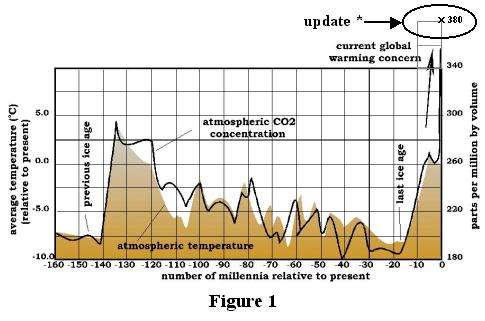
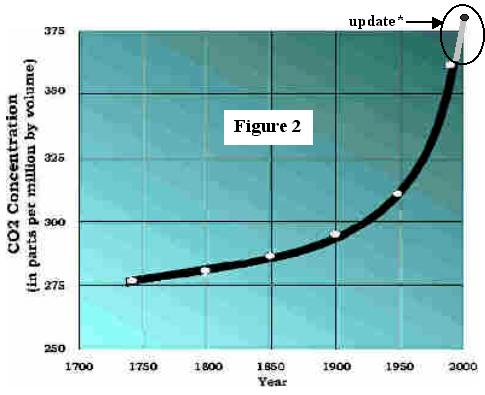
However, there are phenomena for which millennia are reasonable units of time - the natural (uninterrupted) life expectancy of conifers in temperate rain forests, for example. And there are subatomic phenomena, the half-life of which make them easier to understand when they are averaged over such time scales. And the atmospheric temperature at the surface of the earth is such a phenomenon. Climatic variations caused by the elongation of the earth's orbit, volcanic activities, sunspots, giant meteors, etc. create spikes in the data which obscure trends when averages are made over appreciably smaller time scales. In the figure below this temperature data has been plotted with the area colored in below the curve. The abscissa is number of millennia prior to the year 2000 AD. (The curves below have been brought up to the minute by including data since the year 2000 in the circles continuation toward disaster.) In one sense the data seem harmless enough on this scale. Even the great ice ages, although apparent at the left of the plot and 15 or 20 millennia ago, seem fairly minor dips in the temperature when averaged over the whole earth for whole millennia.

Figure 1

But what is truly scary with regard to fever is the juxtaposition of data on atmospheric concentrations of CO2 over the same time interval as the temperature data. It would be difficult to argue that the underlying phenomena were not directly related. See the line plot in the figure. A second figure is provided to show the data with finer precisions since the industrial revolution. The data for CO2 are taken from the concentration in bubbles in ice cores from as much as two miles deep in glacial ice near the poles. The temperature data are derived from tree rings and other fossil growth indicators.

An advanced degree in eschatology from Oral Roberts University is hardly a prerequisite for interpreting this data. A hair raising prediction leaps from the page like "an angel flying through the midst of heaven, saying with a loud voice, 'Woe, woe, woe, to the inhabiters of the earth.'" [Rev. 8:13] All that remains to be revealed in these latter days is exactly how much the inflection in the temperature curve will lag the one in the CO2 concentration curve - maybe "thirty years or so after the year 2000 AD just so people can sneer at millennial fever and then, Bam!" (If Einstein had been a fundamentalist Christian he might have said, "God would have done it that way.") We now know that 1998 was not the year of revelation - the year of man. I guess we'll have to wait and see - the science of global warming is after all, like Christian eschatology, rather imprecise. But don't ignore it!

S/he who hath ears to hear, let her/im hear!

Problems worsen even as the US administration and congress vehemently ignore them!

* The circled data are update the plots to the current year.

Read More...

Sunday, October 22, 2006

Don't Be Just Another Gun Fatality Statistic

by Fred Vaughan

Don't be a statistic

Read More...

Thursday, October 19, 2006

The President's Impact to Personal Prosperity

by Kerry Williams

[Although the following article was written in 2004 and pertained specifically to the resident of the White House which cannot be resolved in a midterm election, constraints on that office can be imposed by a congress of an opposing party. The projections of this article have proven dismally realistic, and although the stock market is momentarily above its disastrous lows, personal prosperity increasingly languishes. --editor]

A popular subject of discussion during election campaigns is the economy and the effect a prospective President may have on it. Typically -- as now -- a sitting President and his opponent will each claim that he will be better than the other for the economy. When the economy is poor, the administration and it's supporters will often claim that the President either has little effect on the economy, or that a poor economy is the fault of his predecessor, or both. In this campaign we are hearing three claims: The President's plan for improving the economy is working, the President really has little effect on the economy, and the problems with the economy should be blamed on his predecessor. Obviously, these three claims are not mutually compatible.

Which claim (if any) is the truth? A close look at prosperity in relation to workers wages and salaries over the past few decades might be revealing.

Let us define prosperity as income minus the present expense of taxes and minus the increase in the deficit, and let's also adjust those numbers for inflation and population growth. This will give us an effective comparison of the economy and fiscal responsibility across the various administrations. It will also provide a good tool for estimating how the average American is doing now in real numbers, and where we are going, fiscally speaking.

At this point in the current election cycle, monthly attempts are being made to estimate total wage and salary income by comparing competing unemployment statistics and then interpreting their accuracy and, independently, the quality of jobs (average salary levels). This seems to be an unnecessary diversion. The IRS already compiles workers total wage and salary income data in conjunction with tax collections. We will use this income data in our chart, adjusted to real per capita year 2000 dollars (y2k$).

The primary expenses deducted from our wages are total personal taxes. This is the expense that we will subtract from the income data.

The deficit that we will deduct from our prosperity curve will be the increase in our gross national debt (GND). Though consumer debt is very large (it is currently nearly 30% the size of our GND) and growing in relation to our national debt, it can be seen to be very little effected by Presidential fiscal responsibility.

Chart of personal prosperity and related data

So our Personal Prosperity (the PP curve with the bold dark line in the chart) is defined as wage and salary income minus paycheck taxes (total IRS receipts minus corporate taxes) and minus the deficit on the national debt, all adjusted per capita to y2k$.

Here are rankings of recent Presidents with regard to Personal Prosperity during their respective terms in office (using the most recent data):

References:

Wages and Income: http://www.irs.gov/pub/irs-soi/01in06pa.xls

Consumer Price Index: http://www.bls.gov/cpi/

Tax collections: http://www.irs.gov/pub/irs-soi/98db09co.xls

Gross National Debt: http://www.publicdebt.treas.gov/opd/opdpenny.htm

Gross Domestic Product: http://bea.gov/bea/dn/nipaweb/TableView.asp#Mid

All charts, data, and calculations available at http://www.giftedgeeks.com/economy/


* Lines on chart are limited to editor's graphic tools. Refer to official sites for more accurate data.

** Economic values pertain to end-of-year, and elected presidents are inaugurated in January.

***Unfortunately, I believe that my projection of the remainder of Bush II's term is accurate. It's not looking good.

Read More...

Wednesday, October 11, 2006

Human Rights and Religion

by Brent Fredrickson

One of the considerations arising out of the topic of Islam in the modern world is that of the clash between human rights and freedom of religion. Members of all religions claim a right to practice their faith as they see fit. But some of the tenets of some religions come into conflict with other rights claimed by people in the modern world, e.g., with the rights of women. Another clash occurs between the rights of one religion and the rights of another. For example, many Islamic scholars contend that there is no right to leave Islam for another religion. Doing so is termed apostasy, considered an "insult to God," and almost always calls for some punishment, often the death penalty. But this position is in clear violation of Article 18 of the Universal Declaration of Human Rights adopted by U.N. General Assembly in 1948.

Article 18.

Everyone has the right to freedom of thought, conscience and religion; this right includes freedom to change his religion or belief, and freedom, either alone or in community with others and in public or private, to manifest his religion or belief in teaching, practice, worship and observance.

Note that this article doesn't just give parents the right to raise their children in the religion of their choice, but provides the clear right of people raised in a religion to leave it. It's this latter right which sets up a direct conflict between a major principle of Islam, the forbidding and the punishing of apostasy and the right of Muslims to leave their religion for another, or for none at all.

What is the appropriate attitude of those of us who are fortunate enough to live in Western democracies to the suppression of rights in some countries in the name of religion and culture? There seem to be two basic approaches to this question, and both of them are frequently voiced.

One answer is that the "imposition" of the "Western" idea of universal human rights on societies which don't want them is a form of cultural imperialism. Who are we, the argument goes, to tell other cultures what sort of rights they must have for their citizens. This view is, of course, a form of cultural relativism.

The other main answer is that there are concepts of human rights which are universal, and which apply to all peoples in all cultures. This is the view which is the basis for the Universal Declaration of Human Rights of the U.N. (1).

I agree with the second view, that of the universality of human rights. First of all, I think a good case can be made that those within repressive societies espousing the point of view that the notion of human rights is a parochial, "Western" notion are often among the oppressors in those societies rather than among the oppressed, so we may suspect their motives as being self-serving. In each of the societies to which this "principle" is applied there are people within those societies who disagree with the notion that they should be considered second-class world citizens in that they may be denied the human rights they seek because those who oppress them argue for some sort of cultural autonomy and "protection from the cultural imperialism of human rights." With respect to those in Western societies holding this view, I think the proper response is that if those who are oppressed by the lack of human rights in other societies don't buy this "cultural imperialism" argument, neither should we.

If the societies under consideration are undemocratic and repressive, a serious question arises as to who actually possesses the legitimacy to speak for the society in terms of discounting the rights of the victims of oppression within it. And when those victims cry out for assistance from sympathizers in democracies, are we to deny them assistance on the grounds that to render it would be a form of cultural imperialism, an unwarranted interference in the affairs of another society?

I would like to distinguish two forms of cultural relativism, a strong form and a weak form. I'm oversimplifying somewhat, because there's actually a continuum of views ranging from the strong to the weak. I consider the opposition to the universality of human rights because of considerations of cultural autonomy to be an example of the application of a strong form of cultural relativism, and I believe the strong form is incoherent, i.e., internally inconsistent. If the strong form were valid, then we would be unable to condemn any kind of behavior in another society approved culturally, because the cultural approval would trump our moral disapproval. So strong cultural relativists would have had nothing to say about the behavior of the Nazis in the Third Reich, because, after all, they were just following their own laws and customs, and it's the essence of strong cultural relativism that this is acceptable.

The notion of cultural relativism in its modern form gained currency based on a century or so of investigation of many cultures around the world by anthropologists. They observed that there are many societies functioning well, but that they seemed to have many different norms and customs. The entirely plausible notion became widespread that cultures in different situations faced different sets of problems and solved these problems by means appropriate to their situation. Hence, a norm which had social utility in one society did not guarantee its utility in another in a different situation. One example of the misapplication of a norm in the wrong context was that of missionaries persuading the natives of some tropical islands that they should wear more clothing, and not follow their custom of being "half-naked," as the missionaries saw things. But these islands had daily intense rainfalls, and the result of the excess clothing was that many got sick and died from walking around in wet clothing. A weak form of cultural relativism takes account of the differing social utility of different customs in different situations as they occur in various cultures. A little thought and the application of this principle likely could have avoided many unfortunate consequences of meddling missionaries.

What the anthropologists failed to do, however, was to notice that there were a number of universal principles which were found in all cultures. They made an inappropriate, though understandable at the time, generalization from the variety of customs they observed to the notion that all customs and morals were relative to time and place. (2).


If we accept the universality of human rights, along with the U.N. in its Declaration with all its signatories, then it's entirely appropriate that we call to account societies which deny people the right to change their religion or which oppress women in the name of culture or religion. The notion that human rights are not for everyone is insulting, I believe, to those who live under oppression in countries outside the West.


(1) The Universal Declaration of Human Rights can be found here: http://www.un.org/Overview/rights.html . It's well worth reading, and may be surprising to many, given how many states signed it. Unfortunately, it's far from being universally honored by those countries which gave their signatures and consent to it.

The rights detailed in the Declaration apply to citizens of all member states of the UN, not just to some subset of Western states for which we've reserved the concept, and since they belong to all citizens of all states in the UN, they therefore impose the relevant duties on those states. I'd argue further that they also impose a duty on those who agree with those rights to speak out for them when they're violated.


(2) Human Universals, D. E. Brown, 1991. For details see:

http://www.robotwisdom.com/ai/universals.html

Read More...

Tuesday, October 10, 2006

"Iraq - Deception and Denial"*

* - A title given to the President's 2003 State of the Union address

"It really comes down to the administration misrepresenting the facts on an issue that was a fundamental justification for going to war. - Joseph Wilson

by Fred Vaughan

(This article was originally published in July 2003, but its message is at least as poignant today as it was then.)

When sexual escapades of a former president rocked this Nation, Kenneth Starr was the man of the hour - year… or rather… years - through our prolonged travail. No stone was left unturned in a sixty-six million dollar pursuit of Truth. And what was that priceless gem of truth with such a costly price tag? President Clinton lied about having had sex with a consenting adult. We now know this as fact because even though both tried their damnedest to hide the ugly fact from us, Kenneth Starr persisted in his sordid "duties" until peeking under sheets on private sex acts became a national pastime. Finally the President's untruths to conceal such facts from us were found by House Republicans to constitute an impeachable offense. As ridiculous as it sounds, that's the truth! Congressmen who had concealed their own infidelities now deemed it treasonous for a President to lie about anything - even that - well, at least "under oath," whatever that means. Truth and Honesty writ large. Henceforth the American people must demand no less of their Presidents?

drawing by Caryl Clark

So is a constitutionally mandated State of the Union address "under oath" or is lying OK in such an informal dispatch of Presidential responsibility? Are there no standards with regard to honesty in Presidential addresses to congress in pursuit of proclamations of war? Or could hoodwinking a nation including its elected representatives with regard to national security matters only frivolously be considered impeachable?

The White House has finally disclosed what everyone in the world with a shred of objectivity suspected even as the words were uttered - that the touted evidence for Iraq attempting to secure uranium from an "African nation" for an alleged program of developing weapons of mass destruction had been trumped up. Eleven months earlier it had been shown by an independent investigation at the behest of the Bush Administration to have been a forgery. Never mind for now who the forgers were. Vice President Cheney had himself sent a special aide, former Ambassador to several African nations and chief US diplomat in Baghdad prior to the first Gulf War, Joseph Wilson, to uncover the truth in Niger. Wilson found the truth and reported his findings that the documents referred to were in fact crude forgeries. This "British Intelligence data" that Bush cited in this regard had also been shown to be bogus by the CIA months before the State of the Union. Of course other "classified British Intelligence data" was cited by the Bush Administration to convince the US Congress to hand its constitutional powers to declare war over to the President. This too was bogus; it was shown to have derived as a mere word-for-word plagiarism from an angry British student's term paper with absolutely no authenticity. This was all well known before President Bush sent troops to battle. This administration's professed reasons for going to war were in fact fabrications! In Joseph Wilson's words to Meet the Press on Sunday July 6th, "That information was erroneous, and they knew about it well ahead of both the publication of the British white paper and the President's State of the Union address."

Donald Rumsfeld and Condoleezza Rice both claim to have known nothing of the forged evidence. They claim that that information had been buried amongst so much data that…well…how could they be expected to have known? Vice President Cheney's office similarly ducks responsibility. Given Wilson's assignment by Cheney and the reported resolution, all these claims seem doubtful at best. A 27-year CIA veteran Ray McGovern, states, "The fact that Cheney's office had originally asked that the Iraq-Niger report be checked out makes it inconceivable that his office would not have been informed of the results." Nor are Wilson and McGovern alone. Greg Thielmann who was Director of the Bureau of Intelligence and Research for the State Department until his retirement last September made these statements at a press conference held July 9th. "I believe the Bush administration did not provide an accurate picture to the American people of the military threat posed by Iraq." And furthermore, that as of the commencement of military operations in March, "Iraq posed no imminent threat to either its neighbors or to the United States." He added, "This administration has had a faith-based intelligence attitude."

But could intelligent people with cognizance of world political situations - even without "classified British intelligence" - really have believed that Saddam Hussein possessed weapons of mass destruction that threatened the security of the United States even without proof of crude forgeries and plagiarism from puerile sources? Or that Saddam Hussein and Osama bin Laden were somehow in cahoots with regard to 9/11 or could even conceivably have resolved longstanding differences to lend credibility to administration justifications for invading a sovereign nation without UN approval? I don't think so. On July 8th, however still trying to strengthen that link, Reuters indicated that an unnamed "US official" claimed an Iraqi had met with 9/11 ringleader Mohammed Atta in Prague shortly before the 9/11 attack. But Newsweek reported on June 9th under the title, "Where are the WMDs?" that: "The hard-liners at Defense seized on a report that Muhammad Atta, the chief hijacker, met in Prague in early April 2001 with an Iraqi intelligence official. Only one problem with that story, the FBI pointed out. Atta was traveling at the time between Florida and Virginia Beach, Va. (The bureau had his rental car and hotel receipts.)"

Also on July 8th that White House spokesman Ari Fleischer finally stated before the press corps that the President's statements during the State of the Union address had been "incorrect." We all know that no one can determine for certain whether untruths (however egregious) have resulted from dishonesty or the perpetrator having unwittingly been duped. But if these were not lies then incompetence of the current administration with regard to our national security interests is so flagrant that either offense would make impeachment imperative would it not?

Nonetheless, on July 11th CIA Director George Tenet took the fall for "wrongly allowing President Bush to tell the American people that Iraq was seeking nuclear material from Africa when analysts had doubts about the quality of the intelligence." In fact the CIA's "doubts" had purged a White House speech in October well before the State of the Union. Tenet contritely stated that he was culpable for not insisting the President remove the comment from his speech once more - whose speech? Whose lies? Ah yes! The Buck Stops where? Immediately following Tenet's abject acquiescence President Bush announced, "I now consider the uranium issue closed!" And does he still have confidence in his scapegoated CIA Director? "Absolutely!" Furthermore, he is without doubt that he did the right thing regardless - "the world is a better place." That's what "faith-based intelligence" is all about.

Where was this guy during Watergate and Whitewater? Surely Kenneth Starr will step out of a phone booth once more - for American family values…won't he?

SUPERSTARR

Read More...