Thursday, September 06, 2007

Fragments

Richard May headshot by Richard May

Nothingness dances dreams of the dead,
soul-eyed shadows of devouring moon.
Star mind feasts upon Orphean strains,
alchemical food of Endless sun.

May-Tzu

crow moon snow

Read More...

Thursday, August 16, 2007

Moment

Richard May headshot by Richard May

The bird's song hears the listening ear.
The wind-blown flame sees the watching eye.
Looking back from the mirror world I see myself,
Remembering now.

May-Tzu

iced rubber ducky

Read More...

Wednesday, August 15, 2007

Zen Spies

Charmaine Frost headshot by Charmaine Frost

Cat drawing
drawing by C. L. Frost

They're all masters of feline Zen, but the ginger one is the master among masters. That's Belleo, my miniature lion with the fiery mane and regal profile; he's the best of the best, the most accomplished of the accomplished. He holds the world's record for staring at nothing; he spent 53 minute and 7 seconds gazing uninterruptedly at a white wall six inches in front of him. Every time I looked at him, I wondered what was so fascinating about that wall. If I had X-ray or UV vision, would I see hundreds of critters scampering over the plaster, all with very long tails?"

Wave a hand in front of his wide amber eyes; he won't even blink. Maybe he just sleeps with his eyes open?

"No, he's meditating on the world's problems," a wise man once told me. "Cats have amazing powers. They can disappear instantly - feline teleportation. They're here, then they're not here; they're prowling up above, silent and unnoticed as shadows, hearing everything. They'd be the perfect spies, if only our linguists could decipher their language and eavesdrop on their gossip."

Read More...

Tuesday, May 01, 2007

Zen Atheist Cat's Got My Tongue

"If the facts prove Buddhist tenets are wrong, the tenets will have to be changed."
—The Dalai Lama

. Sean J. Vaughan headshot by Sean J. Vaughan

I have gotten swept up in the new Atheism wave. And yet I remain Zen Buddhist. Richard Dawkins' "The God Delusion" has outspokenly helped put Athesism back into the global consciousness where it needs to be. Richard Dawkins, Sam Harris, Dan Barker and others are respectfully and reasonably showing the merits and logic of embracing atheism. And I love it! I'm enthused!

However, I have had a deep challenge figuring out whether I can remain Zen Buddhist and at the same time embrace my Atheist roots and understanding. Something as serious as religion best not be taken on faith.

I'm tired of trying to justify the great zen master saying that the cat burgler made the tofu rise to the top of the pot with its mind bullets. (The story: tofu was being stolen, the zen master meditated all night next to the tofu pot, a cat watched the pot until tofu rose to the top, the cat ate the tofu). Sure, the cat indirectly showed the zen master the enlightening fact that the water/tofu temperature inversion can cause tofu to rise in water. But if you don't grasp this temperature inversion, you're not listening to the cat, Mister Master.

And, I'm sorry but there is not a hungry ghost in the plumbing. I don't mind cleaning every speck of food out of my bowl, believe my 250 pounds. But don't tell me any remaining specks going down the rinse are going to choke a hungry ghost.

And as for the zen master enlightening a general by making a river run backwards: THAT'S quite a Mystery Spot. Don't make me go crazy trying to justify craziness.

Many might find me a bit childish for taking the stories so literally. Can I no longer even enjoy secular art, movies, books and such? Well, I usually enjoy those things. I guess giving up all fiction in pursuit of truth might be more difficult than going along with, gasp, faith. Maybe I just need to lighten up. The Middle Path and all. Honestly, though, nobody had a smirk on their face when they told me about the hungry ghosts. What I need, then, is some clear indicator for the important stories. From what I can tell, they're all basically jumbled together.

Good, there is an indicator. When it comes to stories and beliefs, science comes first and the rest come second, or not at all. Our words are not the realities they point to. At the same time, humans have a very basic sense for learning about reality through storytelling and metaphor. This sense is quite possibly more intuitive and refined than our sense of reason at this point in our evolution. Through storytelling, religion can provide an artistic and intuitive way of understanding complex reality just like learning about ourselves by watching a good movie. And, these stories can help us until we need to understand the more complex scientific foundations behind the stories or, more directly, reality itself.

Just don't lead me to believe the foundations are an old white-bearded man out there everywhere pulling the string theories. Or that there's a big bad boogie man (not a God, mind you!) that wants me to do his brand of evil so he can torment my soul for the rest of eternity. Or that cat huffing is imbibing the flying spaghetti monster's body. Or that legendary zen masters could make rivers flow backwards before our eyes. Puh-leez.

I discussed my personal zen athiest dilemma with the abbot of my zen center and he didn't banish me. Phew, what a relief. He noted that zen comes before God, before Atheism, before Buddhism, before words. HUT! Just this. Clean perception mirror. Oh, yeah!

Read More...

Tuesday, December 05, 2006

Games, Simulation and Religion

Sean J. Vaughan headshot by Sean J. Vaughan

Tonight while putting my son to bed I shared some thoughts I have from time to time in terms he could understand...

Virtual Reality

It seems that games will be able to get as realistic as our everyday perceptions. A joint effort between MIT and Harvard has produced rudimentary, synthetic eye interfacing optic nerves with external cameras on eye-glasses. There are several other projects that are working on brain implants for other human-aiding tasks such as allowing quadriplegics to work with a computer. While actual working systems are rudimentary, there don't seem to be any insurmountable physical or technical barriers to interfacing our perceptive organs to synthetic systems.

sketch of Sean J. Vaughan and his son

Using our current perception interfacing agents, joysticks, keyboards, and mice, many people choose to inhabit rich synthetic universes. These universes include Everquest, The Sims, Star Wars Galaxies, Second Life, etc. There are many more.

It is thus easy to imagine a future where we can choose to inhabit a synthetic universe.

From my training in acting and zen, I've found there is a difference to what we think of as acting and what it is to be. One of the main acting guys basically said [good] acting is accepting imaginary circumstance as real and then simply being human.

In zen, we practice kung-ans (Japanese: koans). In a simple sense, these are mind puzzles; for example, one of the most common is, "What is the sound of one hand clapping." These are the lessons taught and learned in Zen. More deeply, these are gates for your self (or soul) to pass through that must be experienced to be answered. There is no room for hesitation, irrelevant thought or acting.

Be it the attainment of life lessons or otherwise, it is easy to imagine a person choosing to embed themselves fully into a simulated universe leaving memories of the real universe behind. Furthermore, for the secret of the real universe to be kept, this simulated universe must only contain others who have fully embedded themselves (i. e., w/o memories of the "real" universe).

At this point, assuming our senses are interfaced and input simulated perfectly and the other players in the synthetic universe are likewise, the synthetic universe is indistinguishable from our own real universe. Also, assuming the rest of our bodies can be simulated (or left behind), that doesn't leave much cause for keeping it around in the real universe.

Astonishingly, if civilization progresses and is able to support a synthetic universe as I've described above, we are likely simulations in a game now.

Ok, so now we have "The Matrix": big deal.

Getting back to my son, he had no response to this. It didn't seem to upset him but I think I succeeded in giving him his first mind fu"¦, er, twist. He was thoughtful about it but didn't have much to say. I may have added to his families' current and future therapy bills but hopefully it's for the good

What my mind's been playing with that I haven't shared with my son (for good reason!) is how religion makes a hell of a lot more sense when given we are living in a simulation. God? He's the fella that created our simulation. Jesus? He used the real universe's Instant Messaging system; yup he was able to get a direct account from here. He's like the first guy that got a gmail account and started inviting the rest of us into the system. Buddha? Whether you're synthetic or not doesn't really change what you are: apples are sweet.

References:

Papers collected under "The Simulation Argument: Are You Living In a Computer Simulation?" Nick Bostrom, PhD; Philosophy Faculty, Oxford University.

General simulated reality info from wikipedia including quality external links.

The Boston Retinal Implant Project.

Everquest.

Star Wars Galaxies.

The Sims.

Second Life.

Read More...

Friday, October 06, 2006

Some Thoughts on Religion

Sean J. Vaughan headshot by Sean J. Vaughan

I have been practising Zen Buddhism for two years.

An interesting paradigm to keep in mind when considering religion is whether it is a subjective or objective religion. Objective religions are religions that describe religious ideas as being outside of our own minds or selves. Belief in gods or a god outside of oneself is an attribute of an objective religion. Eastern religions (or philosophies) are (or tend to be) subjective. The Buddha is not something outside of our own minds or selves.

It indeed seems to me that objective religions are a dying breed. Science seems to be gaining a monopoly in objective thought and all for the better in my opinion.

I myself have been thinking about experiences that are not objective or scientific in the sense that others cannot confirm them. I think it's safe to say that most of us have experiences like these. Science calls these things "hallucinations" and I really have no problem with that description, per se. The problem I do have with that description is that by calling these experiences hallucinations attaches negative connotations to them. Hallucinations are admitted as "normal" only if they come with drugs, illness, or whatever.

When I meditate I see funky colors, and walls look "electric", and all sorts of "stuff." From the first person perspective they are as "real" as (scientific) "reality". Actually, from the first person perspective they are more real than scientific reality because we can not practically experience all that science tells us is true.

I believe that all of our experiences (including hallucinations) can ultimately be complimented by scientific explanations. For example, science can (or will) be able to tell me that when I experienced viewing red this cluster of neurons went ratta-tat-tat. Science could also tell me whether I hallucinated it or whether red was really "out there." Science will eventually be able to explain in technical terms when I experience anger that I'm not understanding that the creep who swore at me has an ulcer which caused 'A' which caused 'B' which caused me to split my knuckles on his chin. As processing power improves hopefully it can save my knuckles or, even better, the swearing, or (even better) the ulcer, or even better, ... The problem is that the science for many of my experiences simply does not exist yet or I don't have time to learn it.

Before the last couple of years I chose to ignore any "abnormal" experiences and label them as bullshit. As it turns out, that is a poor coping strategy! I think science, by its very nature, has a way of minimizing the role of the first-person perspective and that's sad. I'm not stating whether paranormal things happen in the third-person scientific world or not, but paranormal experiences do occur in the first person and are an important part of being human.

I now see science as simply a tool for myself. If my head hits a wall two or three times I can compare notes with others to learn sumpthin'. Or maybe I already read about walls and just avoid 'em because they aren't terribly attractive to begin with. Or maybe I've read about walls but still choose to push on one for experience's sake.

Back to religions...they adapt. Above I said that objective religions are a dying breed but, in fact, they are simply morphing into subjective religions as science takes over their territory. Frankly, if religion helps people without limiting an individual's own ability to help other people (of all, or any, faith) then that's fine with me. (If I were a homeless person though, giving me food with a sermon attached wouldn't really be an example of a religion helping me although it would be an example of an individual helping).

What do others think or feel about this?

Much of what I've discussed here is similar to what I've read in The Myth of Sisyphus by Albert Camus by the way.

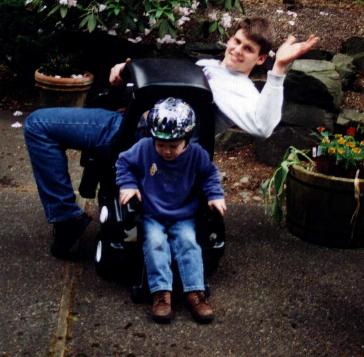
The Author Drives A Toy Truck For His Son

Read More...

Saturday, September 30, 2006

A Visitor From A Type-4 Civilization

Richard May by Richard May
"My" cat, Jessie, a renowned Zen master with cosmological interests, is apparently from a type-4 cat civilization. She is attempting to alter the fabric of space-time in such a way as to broaden the wormholes connecting her universe with parallel universes, which she explained to me are simply other quantum states of this universe from the perspective of her Zen quantum cosmology. Such broadened wormholes are called "mouseholes", according to Master Jessie.

She has not yet revealed to me whether she is simply looking for a safe retreat in which to spend her ninth (parallel) life or is searching for "parallel mice" in the universe next door. At night she claims to disappear into the interstices of brane worlds in pursuit of "dark mice", which may perhaps be exotic subatomic particles. By day she appears to watch creatures unseen by me fly by in higher-dimensional space, which she freely explores in her dream body.

When not meditating on the sound of "her original mew, before the universe was born", she contemplates the implications of super string theory and/or M theory for the movement of her tail. Sometimes I am privileged to eat from her bowl.

Read More...